
Shift4Shop is the hosted e-commerce platform that was called 3dcart until payments company Shift4 bought it in November 2020 and renamed it in January 2021, according to Shift4Shop's own announcement. Shopify is the largest hosted commerce platform for independent brands. Both let you run a full online store without managing servers, and both can handle large catalogues. They make money in very different ways, though, and they suit different kinds of stores.
This comparison covers what each platform costs in 2026, how payments and fees work, what is built in versus what needs an app, how product options and variants compare, themes, SEO and URLs, selling in Canada and abroad, and when each one is the better fit. Facts come from Shift4Shop's plan page and knowledge base and from Shopify's US and Canadian pricing pages, checked on November 10 and 11, 2026. Prices are in US dollars unless marked CAD.
The short answer
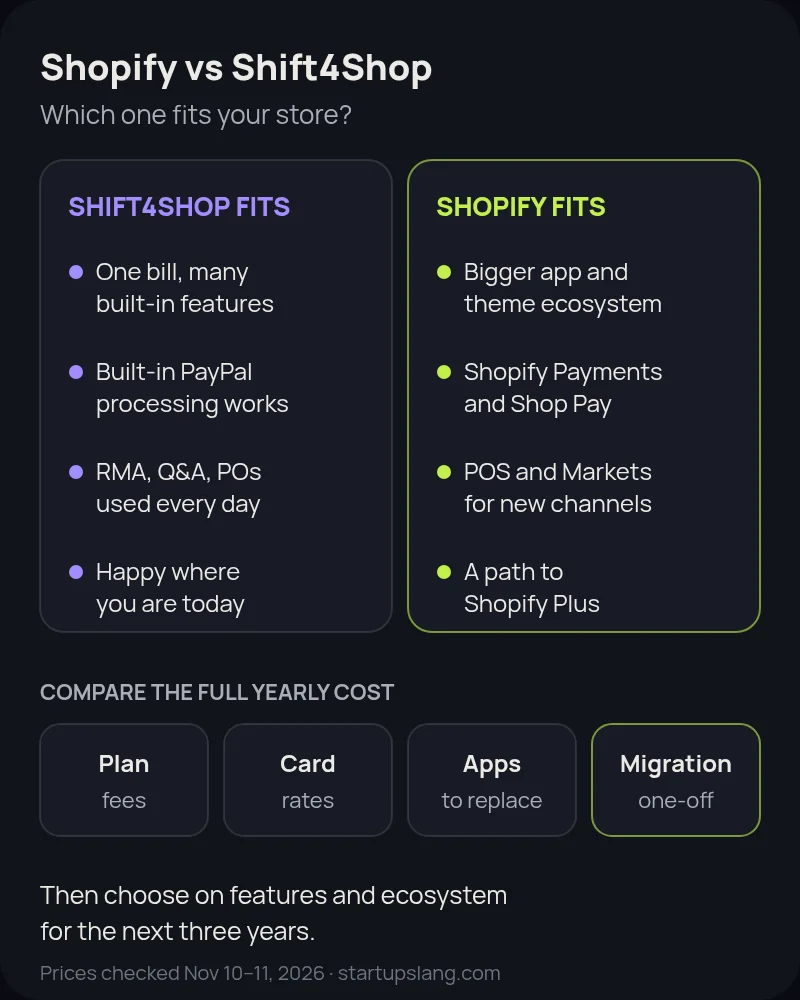
Pick Shift4Shop if you want one low plan fee with a long list of built-in features (real-time shipping, RMA, product Q&A, purchase orders, customer groups) and you are comfortable with its built-in payment processing and a smaller theme and app ecosystem. Pick Shopify if you want the bigger ecosystem, a checkout more shoppers already know, Shopify POS, Markets for selling abroad, a clear upgrade path to Shopify Plus, and the freedom to choose your payment setup. For most growing brands we work with, Shopify is the better long-term platform, but Shift4Shop can be the cheaper one for a feature-heavy store that is happy where it is.
Shopify vs Shift4Shop at a glance
| Comparison | Shift4Shop | Shopify |
|---|---|---|
| Owner | Shift4 (formerly 3dcart) | Shopify Inc. |
| Plan fee (US) | End-to-End plan listed at $41/mo; Shift4Shop's payments page also shows $0 with Shift4 processing and $229/mo with another provider | Basic $29/mo billed yearly or $39 monthly; Grow $89 yearly; Advanced $359 yearly; Plus from $2,300/mo |
| Platform transaction fee | None; your processor's fees still apply | None with Shopify Payments; 2% on Basic with a third-party provider |
| Payments | Built-in processing from PayPal (cards, PayPal, Venmo, Pay Later, Apple Pay, Google Pay) | Shopify Payments and Shop Pay, or a supported third-party provider |
| Products | Unlimited | Unlimited |
| Staff accounts | Unlimited staff users | Grow 5, Advanced 15, Plus unlimited |
| Variants | Options plus Advanced Options; up to 200 Advanced Option combinations per product | Up to 3 options and 2,048 variants per product |
| Themes | 100+ free themes; HTML and CSS editable | Free and paid themes in the Theme Store; Liquid templates |
| Built-in extras | Real-time shipping, labels, RMA, product Q&A, purchase orders, gift wrapping, QuickBooks connector | Core commerce built in; many extras come from the Shopify App Store |
| Default URLs | /Product-Name_p_123.html, /Category_c_7.html or custom file names | /products/handle, /collections/handle |
| Migration in | Shift4Shop says it migrates stores for free | Free Store Migration app for some platforms, plus partners and apps |
Pricing and payment fees
On November 11, 2026, Shift4Shop's End-to-End plan page described "an unlimited, enterprise-grade plan for $41/month" with unlimited products, staff users and bandwidth, no setup fees and no transaction fees. The same page says "a monthly SaaS fee may be charged depending on your plan and monthly processing amount" and offers 10% off for 12 months prepaid. Shift4Shop's End-to-End Payments page tells a different story: its table shows a $0 platform fee when you process with Shift4, $229 a month with another payment provider, and 2.9% + $0.30 card processing on every row. The two pages do not agree, so ask Shift4Shop for your plan fee and processing rate in writing before you compare. In practice, your real Shift4Shop cost is the plan fee plus whatever the processor charges you per sale.
Shopify separates the plan fee from payments. These are the public prices from Shopify's US pricing page (checked November 10) and Canadian pricing page (checked November 11), billed yearly:
| Shopify plan | US (USD) | Canada (CAD) | Online card rate, Shopify Payments (from) |
|---|---|---|---|
| Basic | $29/mo ($39 monthly) | $37/mo | 2.9% + 30¢ US; 2.8% + 30¢ CAD |
| Grow | $89/mo ($105 monthly) | $99/mo | Lower than Basic; 2.6% + 30¢ CAD |
| Advanced | $359/mo ($399 monthly) | $389/mo | Lower again; 2.4% + 30¢ CAD |
| Plus | From $2,300/mo | From $3,400/mo | 2.15% + 30¢ CAD |
A quick way to compare: take last year's online revenue and order count, apply each platform's card rate and per-order fee, add twelve months of plan fees, then add the apps you would need on Shopify to replace Shift4Shop's built-in features. A store with simple needs may find Shift4Shop cheaper on paper. A store that would buy apps for shipping rules, returns and reviews anyway often finds the gap smaller than expected, and the larger ecosystem is worth more than the difference.
Built-in features vs the app ecosystem
This is the clearest philosophical difference. Shift4Shop puts a long list of features into the core plan. Its plan page lists real-time shipping, shipping labels, unlimited product variants and images, inventory control, order editing, a CRM, product Q&A, advanced product options, bulk quantity discounts, single-page checkout, multiple ship-to checkout, digital downloads, customer groups, a QuickBooks connector, saved carts, a purchase order module, an RMA (returns) module and gift wrapping. For a store that uses many of these, that is real value in one bill.
Shopify keeps the core focused on catalogue, checkout, orders, payments, POS and selling channels, then relies on the Shopify App Store for most specialist features. That means more choice and usually better depth (subscriptions, reviews, loyalty, returns, B2B portals, ERP connectors), but also more monthly app fees and more things to maintain. Shopify's own pricing page now also lists a built-in AI assistant on every plan.
If you are on Shift4Shop today, list every built-in feature you actually use. Most have a direct Shopify equivalent or a well-known app. A few, such as purchase order checkout or multiple ship-to addresses in one order, need a specific app or a process change, and it is better to know that before you choose.
Payments and checkout
Shift4Shop is set up to accept cards automatically. Its plan page describes "our integrated payment processing solution from PayPal", with PayPal, Venmo, Pay Later, Apple Pay, Google Pay and the major cards, plus fraud protection from Kount. That is convenient, but it ties your processing to the platform and, per the plan page, the monthly fee can depend on your processing amount.
Shopify gives you Shopify Payments and Shop Pay, its accelerated checkout, in supported countries including the US and Canada, with no platform transaction fee. You can use a third-party provider instead, but Shopify then charges its own fee on top (2% on Basic). Shopify's checkout is the same familiar flow across millions of stores, and Shopify Plus adds a fully customizable checkout. For most brands, a checkout shoppers already trust is worth more than a slightly lower processing rate.
Catalogue, options and variants
Shift4Shop handles complex products with two layers: regular product options and Advanced Options, which give each option combination its own code (SKU), stock, cost and extra weight. Shift4Shop's knowledge base gives up to 200 Advanced Option combinations per product as the supported limit.
Shopify uses up to 3 options and up to 2,048 variants per product, each with its own SKU, price, compare-at price, weight and inventory by location. For most catalogues that is plenty. If you sell products with four or more option sets, such as size, colour, material and finish, you need to combine options, split products, or use an app for the extra choices. We cover the mapping in our Shift4Shop to Shopify migration guide.
For wholesale, Shift4Shop includes customer groups, bulk quantity discounts and a purchase order module. Since April 2026, Shopify's native B2B features (company accounts, catalogs with custom pricing and payment terms) also work on the Basic, Grow and Advanced plans, with a limit of 3 B2B catalogs below Plus; the Plus pricing page lists unlimited B2B catalogs. Our Shopify B2B guide explains what each plan includes.
Themes, design and customization
Shift4Shop offers 100+ free themes and lets you edit HTML and CSS directly, which suits merchants who like full control of templates. Shopify's Theme Store has free and paid themes built on Online Store 2.0, with sections and blocks you can rearrange without code, and Liquid templates when you need custom work. Shopify's theme and developer ecosystem is far larger, so it is easier to find designers, developers and agencies who already know it.
If design and conversion rate are part of why you are comparing, read our Shopify CRO checklist for what usually moves the numbers after a launch.
SEO and URLs
Both platforms give you editable titles, meta descriptions, alt text, canonical tags and XML sitemaps. The differences are in the URLs. Shift4Shop uses product URLs such as /Blue-Flannel-Shirt_p_123.html and category URLs such as /Mens-Shirts_c_7.html unless you set custom file names. Shopify uses fixed prefixes: /products/handle, /collections/handle, /pages/handle and /blogs/news/handle.
Neither structure is a ranking problem on its own. Content, speed, internal links and structured data matter more. The URL structure matters most when you switch, because every old URL needs a 301 redirect to its new home. Shift4Shop's own redirects stop working once your domain points to another platform, so they have to be rebuilt in Shopify. Our Shopify migration SEO checklist covers the full process.
Selling in Canada and abroad
Shift4Shop's real-time shipping integrates with carriers including USPS, UPS, FedEx, Canada Post, Australia Post and Royal Mail, according to its homepage. Shopify adds Markets, which lets you set country-specific prices, currencies, domains and languages from one store, and the Advanced plan lists tailoring your store by region. For a Canadian brand selling into the US, or a US brand adding Canada and Europe, Shopify's Markets tools are usually the deciding factor. Shopify Payments is also available directly in Canada, with Canadian card rates on the Canadian pricing page.
When to choose each one
| Your situation | Better fit |
|---|---|
| You rely on many built-in Shift4Shop features and want one low bill | Shift4Shop |
| You are happy with the built-in PayPal processing and your current rate | Shift4Shop |
| You want a larger theme, app and developer ecosystem | Shopify |
| You sell in person and want one inventory across shop and store | Shopify (Shopify POS); Shift4Shop also lists a point-of-sale option, so compare both |
| You sell into several countries or currencies | Shopify (Markets) |
| You sell wholesale as well as direct | Shopify (native B2B on Basic and up; Plus for more than 3 catalogs or a custom checkout) |
| You want to choose your payment provider freely | Shopify |
Also comparing other platforms? See Shopify vs BigCommerce, Shopify vs WooCommerce, Shopify vs Wix and Shopify vs Squarespace.
If you decide to switch
Moving from Shift4Shop to Shopify is a well-understood project. Shift4Shop exports products, options, Advanced Options, categories, customers and orders as separate CSV files. Shopify's free Store Migration app does not list Shift4Shop as a source, so the files need reshaping to Shopify's product CSV, or you can use a third-party migration service such as Cart2Cart or LitExtension. The two things that most often go wrong are Advanced Options losing their SKUs, stock and weights, and old _p_ and _c_ URLs left without redirects.
Before you start, check who registered your domain (Shift4Shop offers free registration, so it may be in their account), what your payment processor contract says, and which built-in features you need to replace. Then follow the step-by-step plan in our Shift4Shop to Shopify migration guide. A simple store can move in about two weeks; large catalogues with Advanced Options and years of orders usually take four to six.
How Startup Slang helps
We help brands choose a platform and then build, migrate and grow on it. Our team has moved stores to Shopify from Magento, WooCommerce, BigCommerce and Salesforce Commerce Cloud, and our guides cover Shift4Shop, Volusion, Ecwid, OpenCart and PrestaShop moves. If you are deciding between Shopify and Shift4Shop, we will compare your real yearly cost, list the features you would need to replace, and give you a straight answer. If Shopify is the right call, our Shopify migration team handles data, redirects, theme and apps from Toronto and Montreal, and our Shopify agency team takes it from there.
Frequently asked questions
Is Shopify better than Shift4Shop?
For most growing brands, yes: Shopify has a much larger theme, app and developer ecosystem, Shopify Payments and Shop Pay, POS, Markets for selling abroad and an upgrade path to Shopify Plus. Shift4Shop can be the better fit for a store that relies on its many built-in features and is happy with its built-in payment processing.
Is Shift4Shop cheaper than Shopify?
Sometimes. On November 11, 2026, Shift4Shop's plan page listed its End-to-End plan at $41 a month, while its payments page showed a $0 platform fee when you process with Shift4 (2.9% + $0.30 per card sale) and $229 a month with another provider. Ask for your rate in writing. Shopify Basic is $29 a month billed yearly or $39 monthly in the US, with 2.9% + 30¢ online card rates on Shopify Payments. Compare plan fees, card rates and the apps you would need on Shopify, not just the plan price.
Does Shift4Shop charge transaction fees?
Shift4Shop's plan page says there are no setup fees or transaction fees and that you only pay your payment processor's normal fees. Its built-in card processing comes from PayPal. Shopify charges no platform transaction fee with Shopify Payments, but adds a fee (2% on Basic) if you use a third-party payment provider.
Is Shift4Shop the same as 3dcart?
Yes. Shift4 bought 3dcart in November 2020 and renamed it Shift4Shop in January 2021. Many long-running stores still use 3dcart-style URLs such as /Product-Name_p_123.html and the 3dcart knowledge base.
Which is better for SEO, Shopify or Shift4Shop?
Both cover the basics: editable titles and meta descriptions, alt text, canonical tags and sitemaps. Content, speed and site structure matter more than the platform. The URL format only becomes important when you switch, because every old Shift4Shop URL needs a 301 redirect to its new Shopify URL.
Can I move from Shift4Shop to Shopify?
Yes. Shift4Shop exports products, options, Advanced Options, customers and orders as CSV files, which you reshape to Shopify's product CSV or move with a third-party service such as Cart2Cart or LitExtension. Shopify's free Store Migration app does not list Shift4Shop. Our Shift4Shop to Shopify migration guide covers each step.
How many variants can a product have on Shopify vs Shift4Shop?
Shopify allows up to 3 options and 2,048 variants per product. Shift4Shop uses product options plus Advanced Options, and its knowledge base gives up to 200 Advanced Option combinations per product as the supported limit.