
Volusion has powered online stores since the late 1990s. It is still a hosted platform with its own checkout, Import/Export tools and a long list of older stores that rank on Google. As those stores grow, many owners want Shopify's theme library, app ecosystem, Markets and Checkout Extensibility. That is when a Volusion to Shopify migration comes up.
This guide covers what the move involves in 2026: how Volusion and Shopify pricing compare, what Volusion lets you export, why Shopify's free Store Migration app does not list Volusion as a source, how to map Volusion CSVs and child products into Shopify variants, how Volusion's distinctive URLs should redirect, and the launch order that protects search traffic. Every fee and limit comes from Shopify's and Volusion's own pricing and help pages, checked on November 6, 2026. Prices are in US dollars. Both companies price differently in Canada and other countries, so check your local page.
Why sellers leave Volusion for Shopify
Volusion's public pricing page sells on a low total cost of ownership, but every plan also carries a yearly GMV (gross merchandise volume) cap and a product cap. Hit either ceiling and you move up a plan. Shopify does not publish a GMV cap on Basic, Grow or Advanced, and every plan includes unlimited products, a custom domain and abandoned checkout recovery.
Here is how the published monthly plans line up, using Volusion's pricing page and Shopify's pricing page.
| Plan comparison | Volusion Personal | Volusion Professional | Shopify Basic |
|---|---|---|---|
| Monthly plan | $35 | $79 | $29 billed yearly, or $39 monthly |
| Product limit | 100 | 5,000 | Unlimited |
| Yearly GMV cap | $50,000 | $100,000 | None published |
| Staff accounts | 1 | 5 | Owner only on Basic; Grow adds 5 |
| Online card rate | Depends on gateway | Depends on gateway | 2.9% + 30¢ with Shopify Payments |
| Custom domain | Included | Included | Included |
Volusion Business is listed at $299 a month with annual payment, or $399 monthly, with unlimited products, a $400,000 yearly GMV cap and 15 staff accounts. Shopify Advanced is $299 a month billed yearly or $399 monthly, with no GMV cap. Volusion also notes that additional fees may apply if you are not on a preferred payment gateway. Shopify charges a 2% fee on Basic if you use a third-party payment provider instead of Shopify Payments.
Beyond price, sellers usually move for the app store, Markets for international selling, a larger theme ecosystem and Shopify POS. Volusion still works for stores that fit inside its plan caps and are happy with its native tooling. Once the catalog, sales or channel needs outgrow those caps, Shopify is the usual next step.
What moves from Volusion to Shopify, and what doesn't
Volusion exports data table by table through Inventory > Import/Export. Shopify's help centre says you should import products first, then customers, then historical orders that are already fulfilled, so products and customers can attach to those orders correctly.
| Data | How it leaves Volusion | How it gets into Shopify |
|---|---|---|
| Products and child products | Standard Export of the Products table (CSV, TAB, PIPE or XML), or a Saved Export | Edited Shopify product CSV, Matrixify, Cart2Cart or LitExtension |
| Categories | Categories table export, or category links in a Saved Export | Shopify collections (manual or app) |
| Customers | Customers table export or Saved Export | Shopify customer CSV or a migration app |
| Orders | Orders export, Saved Export, or Volusion's API (XML, limited per call) | Migration apps only (Shopify has no order CSV import) |
| Reviews | Depends on the reviews add-on; often a separate export | Reviews apps such as Judge.me, Loox or Yotpo |
| Customer passwords | Cannot be exported in a usable form | Customers reset passwords on first login |
| Page URLs | Stay on the old store until the domain moves | 301 redirects in Shopify |
Shopify's free Store Migration app lists Square, WooCommerce, Etsy, Wix, Amazon, eBay, Clover and Lightspeed R/X as sources. Volusion is not on that list, so you either reshape Volusion CSVs to Shopify's templates or use a third-party migration app.
Export from Volusion the right way
Volusion's own Import/Export help page is the source of truth for how data leaves the store. Go to Inventory > Import/Export in the Admin Area.
- Standard Export: pick one table (for example Products or Customers), choose the columns you need, pick CSV as the format, and click Export. Large tables can time out, so Volusion recommends splitting big exports.
- Export Wizard: a guided alternative to Standard Export when you want help picking columns.
- Saved Exports: custom SQL-style queries under the Saved Exports tab. Useful when you need a stable product or customer extract you can re-run before launch.
- Formats: CSV, TAB, PIPE and XML. Shopify's product and customer importers expect CSV, so start there unless an app asks for something else.
For products, export at least ProductCode, ProductName, ProductDescription, ProductDescriptionShort, ProductPrice, ListPrice, SalePrice, ProductWeight, StockStatus, PhotoURL_Large, PhotoURL_Small, METATAG_Title, METATAG_Description, ProductManufacturer, UPC_code, IsChildOfProductCode and category links if your Saved Export includes them. Child products (rows where IsChildOfProductCode points at a parent) become Shopify variants later, so keep that column.
For customers, export email, name, phone, addresses and any marketing opt-in field you use. Shopify's customer CSV needs Accepts Email Marketing as yes or no, and a country code on addresses. For orders, only move fulfilled historical orders if you need them in Shopify for customer service; keep Volusion as the archive if you do not.
Option 1: Map the Volusion CSV to Shopify's product template
If your catalog is manageable and you want clean handles and variant structure, edit the Volusion Products export to match Shopify's product CSV and import it under Products > Import.
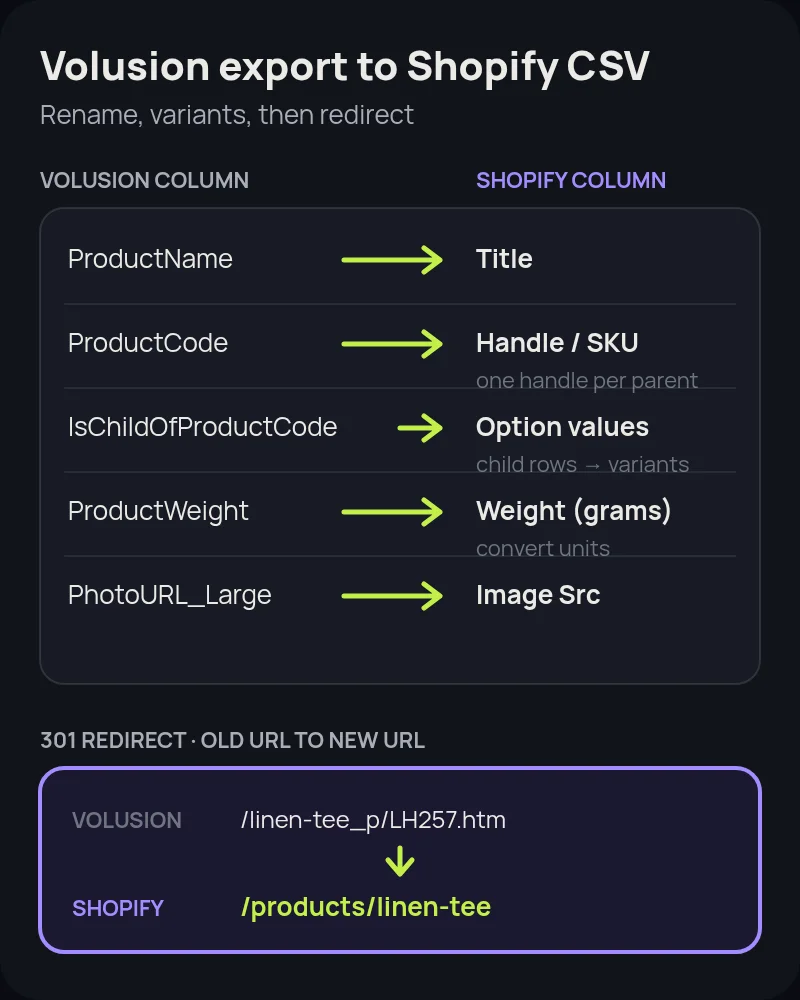
- Handle: build a Shopify handle from ProductName or from Volusion's Product URL Text. Handles can only contain letters, numbers and hyphens. Keep one handle per parent product so every child row shares it.
- Title and body: ProductName becomes Title. ProductDescription becomes Body (HTML). Shopify accepts HTML in that column.
- Variants from child products: Volusion often stores options as separate child products linked with IsChildOfProductCode. On Shopify, those become Option1 Name / Option1 Value rows under the same Handle, each with its own Variant SKU (usually the child's ProductCode), Variant Price and Variant Inventory Qty.
- Prices: ProductPrice or SalePrice maps to Variant Price. ListPrice can become Compare At Price when it is higher than the selling price.
- Weights: Shopify's CSV wants variant weight in grams unless you set the unit column. Convert pounds or kilograms before import.
- Images: PhotoURL_Large (and additional image URLs if you export them) become Image Src. Image URLs must stay publicly reachable during the import.
- SEO fields: METATAG_Title and METATAG_Description become SEO Title and SEO Description.
- Vendor and type: ProductManufacturer can become Vendor. Category names often land in Type or Tags, then you build collections from them.
Delete Volusion columns that Shopify does not recognise before you import. After import, open a sample of parent products with many options and confirm variant counts, prices and images. Rebuild any product whose options do not fit Shopify's three-option / 100-variant ceiling.
Option 2: Use a migration app
For larger catalogs, order history, reviews or automated redirects, a migration app is usually faster than hand-editing CSVs.
- Cart2Cart: supports Volusion as a source. Connection typically uses a bridge file on the Volusion store. It can move products and variants, categories, customers, orders, coupons and reviews, with 301 redirects as an option.
- LitExtension: also supports Volusion to Shopify. Its docs note that only users with customer status migrate as customers, and that passwords cannot transfer, so buyers reset on first login.
- Matrixify: strong when you can first get Volusion data into its Excel/CSV templates. Useful for complex catalogs and for re-running imports during staging.
Run a demo or small pilot first. Compare product counts, variant counts, customer emails and a handful of order totals against Volusion before you pay for a full run. Keep Volusion live during the transfer so you can capture delta orders near launch.
Protect your search traffic with redirects
Volusion URLs look nothing like Shopify's. That is the SEO risk of the move. Volusion's help docs describe two product URL styles:
- Default:
/ProductDetails.asp?ProductCode=LH257 - Search-engine-friendly (Marketing > SEO):
/product_p/lh257.htm, or/linen-tee_p/lh257.htmwhen Product URL Text is set
Categories use /SearchResults.asp?Cat=1 by default, or /shirts_s/1.htm with friendly URLs. Custom articles use paths like /companyhistory_a/1.htm. On Shopify, products live at /products/linen-tee, collections at /collections/, and pages at /pages/.
- Crawl before you switch. Export ranking URLs from Google Search Console and crawl the Volusion store so you have every
_p/,_s/,_a/and.aspaddress that gets traffic. - Map one-to-one. Each old product URL should 301 to its new
/products/handle. Categories become collections. Articles become pages or blog posts. - Create redirects before the domain moves. In Shopify, go to Content > Menus > View URL redirects, or import a redirect CSV.
- Disconnect the domain from Volusion first. Shopify warns that a domain still pointed at the old platform can cause SSL certificate errors when you connect it.
- Submit the new sitemap in Search Console after launch, and spot-check your top old URLs by hand.
Our Shopify migration SEO checklist covers titles, structured data and post-launch monitoring in more detail.
Volusion to Shopify migration, step by step
- Audit the Volusion store: product count vs plan caps, child-product patterns, apps, payment gateway, shipping rules, and a full URL list from Search Console plus a crawl.
- Open a Shopify store on a trial or paid plan and pick a theme. Do not connect the live domain yet.
- Export from Volusion: Products (with IsChildOfProductCode), Customers, Categories, fulfilled Orders if needed, and image URL lists.
- Import products via an edited Shopify CSV or a migration app. Fix variants, weights, images and compare-at prices. Set sellable products to active only when they look right.
- Import customers next, then historical fulfilled orders if you are bringing them over. Turn off new-order notification emails before an order import so staff are not flooded.
- Rebuild what exports skip: collections from old categories, navigation, About/shipping/returns pages, gift cards, discount codes and apps (reviews, subscriptions, loyalty, ERP).
- Configure payments, shipping and taxes, then place test orders, including a failed payment and a refund.
- Load the redirect map for every important Volusion URL. Test a sample on a temporary domain or after hosts-file testing if you can.
- Disconnect the domain from Volusion, connect it to Shopify, wait for DNS and SSL, submit the Shopify sitemap, and monitor 404s.
- Cancel or downgrade Volusion only after orders flow on Shopify and Search Console looks stable. Keep a Volusion admin backup/export for your records.
How long a Volusion migration takes
Timelines vary with catalog complexity more than with platform brand.
- Small catalog (under a few hundred SKUs, few child products): about one to two weeks for data, theme setup, redirects and testing if someone is on it full time.
- Mid-size catalog with many child products and apps: three to six weeks is common, including a staging review and a redirect QA pass.
- Large or heavily customised Volusion stores (custom ASP pages, complex pricing levels, ERP links): plan for two to three months, often with a Partner or agency.
Build in a freeze window before cutover so new Volusion products and price changes can be re-exported. Apps that offer a recent-data or delta migration help close that gap on launch day.
Common mistakes to avoid
- Assuming the Store Migration app supports Volusion. It does not list Volusion. Plan for CSV mapping or a third-party app from day one.
- Importing child products as separate Shopify products. You end up with orphan SKUs instead of variants. Group by parent ProductCode / IsChildOfProductCode first.
- Skipping weight unit conversion. Wrong grams throw off every carrier rate.
- Leaving image hosts unreachable. If PhotoURL values 404 during import, Shopify stores broken images.
- Moving the domain before redirects exist. Ranked
_p/and.aspURLs will 404 and leak equity. - Promising password continuity. Customers will need a reset link. Tell them before launch.
- Importing open or unfulfilled orders. Shopify recommends historical fulfilled orders only.
How Startup Slang helps
We have moved brands to Shopify from Magento, WooCommerce, BigCommerce and Salesforce Commerce Cloud, and our Wix, Squarespace, Etsy, Square and PrestaShop guides cover moves from website builders, marketplaces, POS-led stores and open-source stacks. A Volusion move centres on child-product variants and those _p/ / .asp URL maps. Our Shopify migration team handles the data, redirects, theme and apps from our offices in Toronto and Montreal. If you are still choosing a platform, our Shopify agency team can help you pick a plan and a build approach.
Frequently asked questions
Does Shopify's Store Migration app support Volusion?
No. Shopify's Store Migration app lists Square, WooCommerce, Etsy, Wix, Amazon, eBay, Clover and Lightspeed R/X as sources. Volusion is not on that list, so you reshape Volusion CSVs to Shopify's templates or use a third-party migration app such as Cart2Cart, LitExtension or Matrixify.
How do I export products from Volusion?
In the Volusion Admin Area go to Inventory > Import/Export, open Standard Export, choose the Products table, select the columns you need, pick CSV and click Export. For a reusable extract, create a Saved Export. Large tables can time out, so split big catalogs.
What happens to Volusion child products on Shopify?
Volusion often stores options as child products linked with IsChildOfProductCode. On Shopify those become variants under one parent Handle, each with its own SKU, price and inventory. Importing every child as a separate product creates orphan SKUs.
Will customer passwords move to Shopify?
No. Passwords cannot be migrated from Volusion in a usable form. Customers sign in on Shopify with a password-reset link. Tell them before launch so support is not flooded on day one.
How do Volusion URLs redirect to Shopify?
Default Volusion product URLs look like /ProductDetails.asp?ProductCode=LH257. With search-engine-friendly URLs enabled they look like /linen-tee_p/lh257.htm. Map each one to its new /products/ handle with a 301 redirect in Shopify before you move the domain.
Is Shopify cheaper than Volusion?
It depends on plan and volume. Volusion Personal is $35 a month with a 100-product and $50,000 yearly GMV cap. Shopify Basic is $29 a month billed yearly or $39 monthly with unlimited products and no published GMV cap. Compare staff limits, payment fees and apps for your store.
How long does a Volusion to Shopify migration take?
A small catalog can move in about one to two weeks. Mid-size stores with many child products and apps often need three to six weeks. Large or heavily customised Volusion stores can take two to three months.