BigCommerce is a strong choice for merchants with large, complex catalogs, B2B needs and a preference for flexible, open architecture. Startup Slang designs and develops BigCommerce stores, and we know the platform well enough to tell you honestly when it is the right fit and when Shopify would serve you better.
Our BigCommerce work: Atlas Tools & Machinery
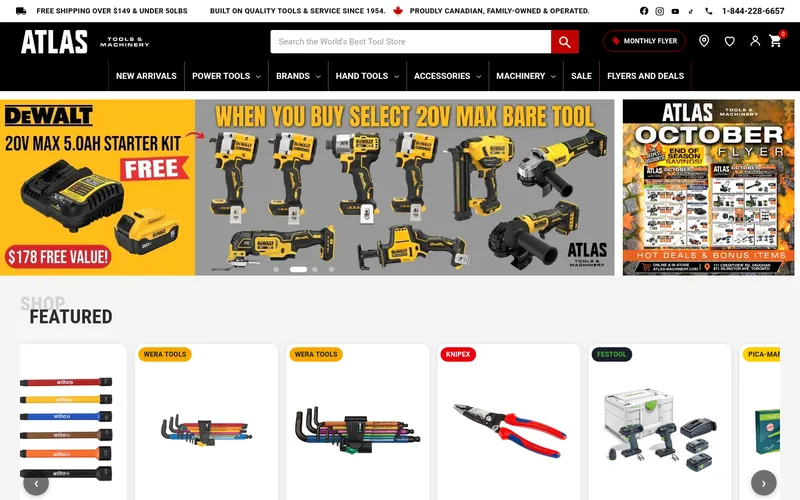
Atlas Tools & Machinery is a third-generation family business selling machinery, power tools and accessories from its retail home in downtown Toronto, backed by a large warehouse and brands such as Festool, Knipex, Stihl and Diablo. Its catalog is deep and technical, spread across many brands and categories, with regular flyers and deals.
We built the store on BigCommerce around how tradespeople actually shop: by category, by brand and by deal. Then we kept going with conversion work and marketing. It is a good example of where BigCommerce shines: lots of SKUs, detailed product attributes and customers who know exactly what they want and need to find it fast.
BigCommerce services
- Store design. Custom Stencil theme design and UX for category, search and product pages.
- Development. Theme development, custom features, apps and API integrations.
- Catalog architecture. Categories, brands, product options, custom fields and faceted search for large catalogs.
- B2B. Customer groups, price lists, quotes and wholesale features with B2B Edition.
- Integrations. ERP, POS, inventory, shipping and marketplace connections.
- Headless BigCommerce. Custom frontends using BigCommerce's APIs where a theme is limiting.
- Migrations. Moves to BigCommerce, or from BigCommerce to Shopify if that suits you better.
- Growth. CRO, SEO, email and paid advertising, plus AI automation.
When BigCommerce is the right platform
BigCommerce tends to suit merchants who:
- Have large catalogs with many options, attributes and brands
- Sell B2B and B2C from the same platform
- Want more built-in features without relying heavily on apps
- Want flexibility in payment gateways
- Plan a headless or multi-storefront setup
Shopify tends to suit brands that prioritise checkout conversion, a vast app ecosystem, built-in marketing tools and simplicity for day-to-day teams. We build on both, so our recommendation is not tied to one platform. Our guide to Shopify vs. BigCommerce compares them in detail.
Thinking of leaving BigCommerce?
If your team is struggling with your current setup, we will first check whether the platform is the problem or the implementation is. Sometimes a redesign and a cleaner catalog solve it. If a move makes sense, our Shopify migration process protects your products, customers, orders and search rankings.
Why Startup Slang for BigCommerce
- Real BigCommerce work in Canada, including a technical retail catalog in Toronto.
- Platform-honest advice. We also build on Shopify and Shopify Plus, WooCommerce and custom stacks.
- Growth after launch. Development, marketing and AI under one roof.
- Two offices. Toronto and Montreal, serving brands across Canada and the US.
How a BigCommerce project runs
- Discovery of catalog, integrations, B2B rules and goals.
- Information architecture for categories, brands and filters.
- Design and build on a sandbox store.
- Data, integrations and QA.
- Launch, redirects and growth.