Paid social now runs on video. Meta, TikTok and YouTube Shorts reward advertisers who can put fresh, native-looking creative in front of people every week, and most brands simply cannot film that much. AI video tools close part of that gap: they can draft scripts, cut a long take into a dozen hooks, translate a voiceover, resize for every placement and, in some cases, generate a presenter or a scene. Used carelessly, they also produce ads that look fake, break platform rules or put words in a real person's mouth.
Startup Slang is an AI-first agency for marketing and development, founded in 2017 and based in Toronto and Montreal. As an AI video ads agency, we combine real creator UGC with AI-assisted scripting, editing, versioning and localization, and we treat disclosure and consent as part of the brief, not an afterthought. We work with brands across Canada, the United States and Europe, in English and French.
This page explains what AI video ads and AI UGC ads are, the formats we produce, how AI fits with real creators, how a project runs, which platforms we build for, how we test, the disclosure and compliance rules we design around, what affects the cost and how to choose a partner. It is part of our AI services and sits next to our UGC video and paid ads teams.
What AI video ads and AI UGC ads are
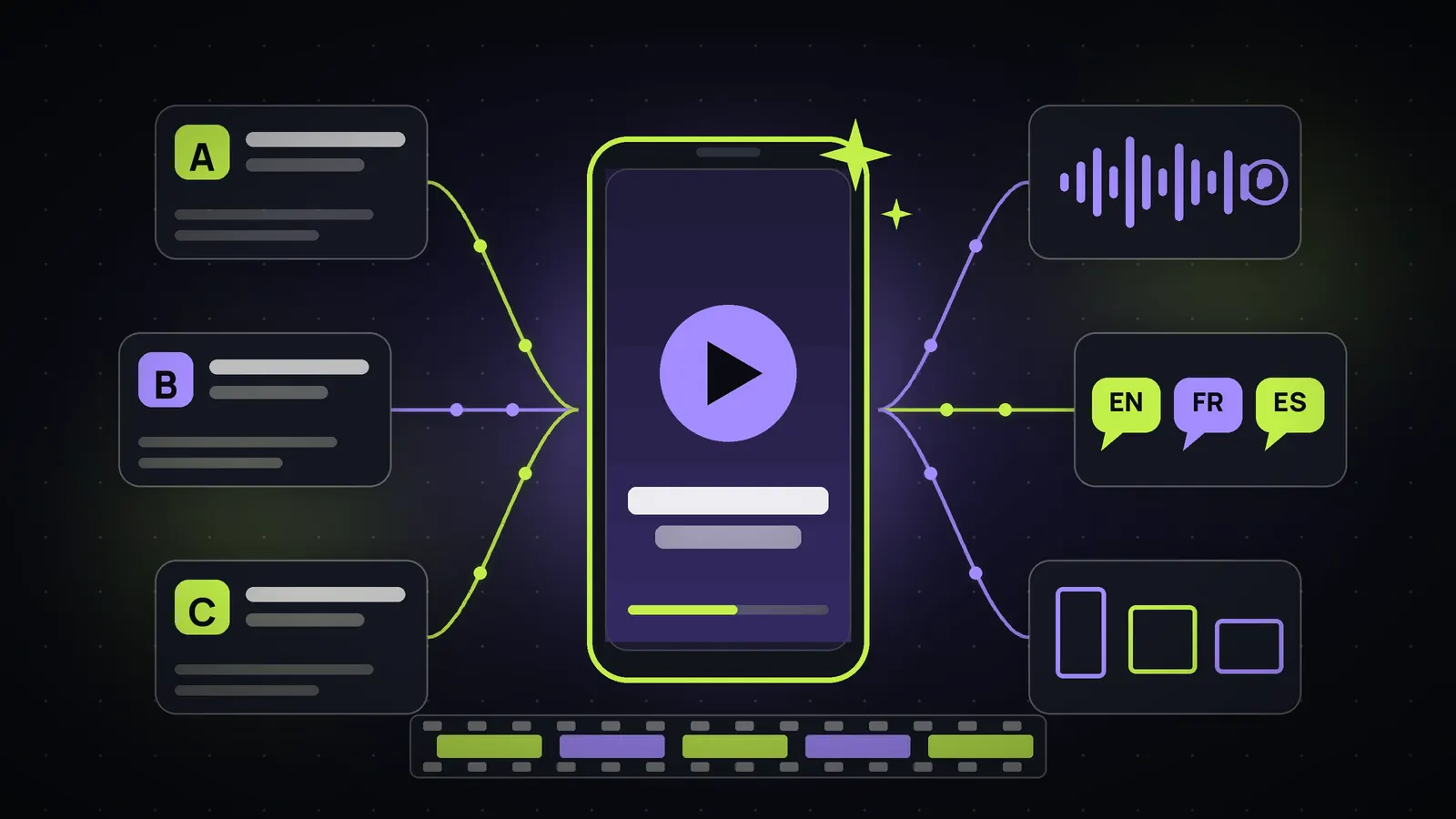
AI video ads are video advertisements where artificial intelligence does part of the work: writing or adapting the script, editing footage, generating b-roll, motion graphics or backgrounds, producing a voiceover, translating and dubbing, or creating dozens of variations from one master. The footage can be fully filmed, partly generated or, in a smaller number of cases, fully synthetic.
UGC ads (user-generated content ads) are short videos in the style of a real customer or creator: talking to camera, unboxing, showing a product in use, reacting or explaining. They work because they look like the content people already watch in their feeds. AI UGC ads use AI somewhere in that chain. Sometimes that means AI-assisted editing and versioning of footage a real creator filmed. Sometimes it means a synthetic presenter, an AI avatar, delivering a script. These are very different products with different rules, so we always say which one we are proposing.
| Approach | What it is | Best for | Watch out for |
|---|---|---|---|
| Creator UGC | A real person films the product and shares a genuine view. | Trust, testimonials based on real use, demonstrations. | Volume, turnaround, usage rights. |
| AI-assisted creator UGC | Real creator footage, with AI used for scripts, edits, hooks, captions, resizing and translation. | Testing many hooks and markets from one shoot. | Keeping edits honest to what the creator actually said. |
| AI avatar or synthetic presenter | A generated or licensed digital presenter reads a script. | Explainers, product walkthroughs, fast localization. | Labelling, likeness consent, never posing as a real customer. |
| Generated scenes and motion | AI-generated product scenes, backgrounds, b-roll or animation. | Concepts, seasonal versions, visuals hard to film. | Product accuracy and realistic-content disclosure. |
AI video ad formats we produce
Short-form vertical ads
Nine-by-sixteen video for Reels, Stories, TikTok and YouTube Shorts, usually 6 to 45 seconds, built around a hook in the first seconds, captions for sound-off viewing and a clear next step. We plan safe zones so text is not hidden by each platform's interface, and we export square and landscape cuts where placements need them.
Product demos and explainers
Close-up demonstrations, feature walkthroughs, before-and-during-use sequences and comparison formats that show how a product works. AI helps with storyboards, motion graphics, background clean-up and generated b-roll. The product itself should be shown as it really is, so we film real units and use generation for context, not for the thing you are selling.
AI avatars and synthetic presenters
For explainers, onboarding videos, app walkthroughs and fast localization, a synthetic presenter can read a script in many languages without a reshoot. We only use avatars built from stock presenters licensed for advertising or from a real person who has given written consent for that specific use. Avatar ads are presented as what they are: a presenter, not a customer, and never a review.
Voiceover, dubbing and localization
AI voice and dubbing tools can turn an English master into French, Spanish, German or other versions quickly. We use fluent reviewers to check translations for meaning, tone and local claims, adjust on-screen text and offers for each market, and only clone a voice when the owner has agreed in writing. For Canadian campaigns, French versions are reviewed by French speakers, not just machine output.
Hook and iteration variants
Most of the performance gain in paid social comes from testing different openings, angles and offers, not from polishing one ad. From each concept we produce structured variants: different first lines, opening shots, captions, lengths, calls to action and end cards, so each test answers a clear question.
Editing and post-production with AI
AI speeds up the unglamorous work: transcription and captions, cutting silences, finding the best takes, reframing for vertical, colour matching, audio clean-up, background removal and resizing. Editors still make the creative decisions and check every frame before anything goes out.
How AI video pairs with real creator UGC
We do not see AI as a replacement for real creators. People trust people, and a genuine customer or creator using a product is something a synthetic presenter cannot honestly imitate. What AI changes is how far one real shoot can go.
- Real creators for proof. Anything framed as an opinion, a result or a recommendation comes from a real person who has used the product, under our UGC video process with written usage rights.
- AI for range. One creator session becomes many hooks, lengths, sizes and languages, without changing what the creator actually said.
- AI for gaps. Scenes that are hard or costly to film, product animations, seasonal backdrops and explainers can be generated or assisted, and labelled where the rules require it.
- Influencers for reach. When you also want a creator's audience, our influencer marketing team handles partnerships and whitelisting.
The result is a creative library that mixes authentic creator content with AI-assisted versions, so you can test more without asking anyone to say something they do not believe.
How we work: brief to iteration
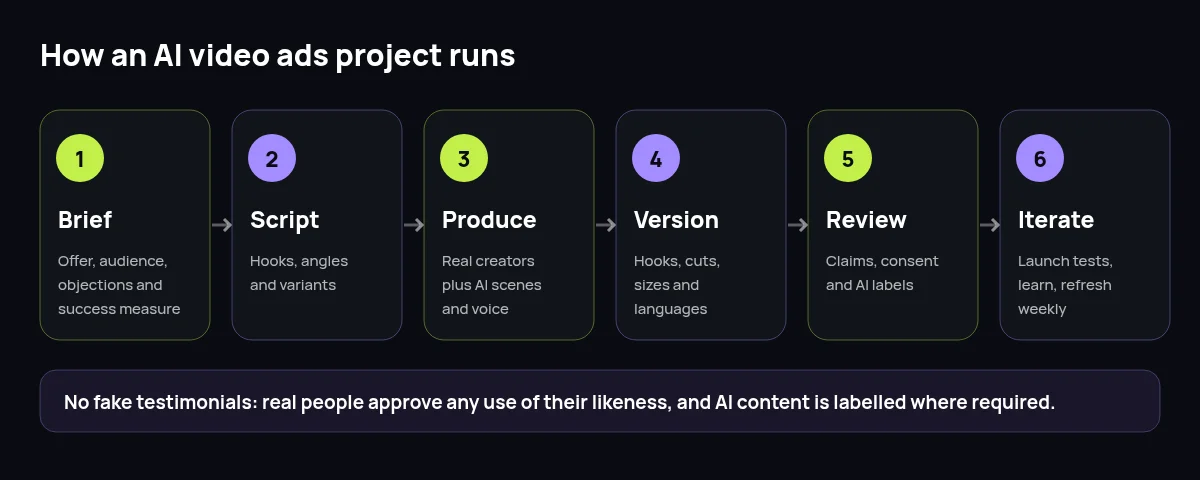
- Brief. We start from your offer, your customer and the objections people have before buying, then agree one success measure for the first round, such as cost per purchase, cost per lead or thumb-stop rate. We review the creative and data you already have so we do not repeat old tests.
- Script. We write concepts and scripts with several hooks and angles each, using AI to explore options and draft variations and people to choose and sharpen them. Claims are checked against what you can substantiate.
- Produce. Real creators film where authenticity matters. AI produces what it does well: scenes, motion, backgrounds, licensed avatar explainers and voiceovers. Every creator and voice is covered by written consent and usage terms.
- Edit and version. Editors build the masters, then use AI-assisted tools to cut hooks, lengths, aspect ratios, captions and languages, naming each file so results can be read later.
- Review and label. Before launch we check claims, disclosures of paid relationships, likeness and voice permissions, music rights and each platform's AI labelling rules, and we record what AI did in each asset.
- Launch, test and learn. We launch structured tests with the paid ads team or yours, report what won and why, retire what lost and feed the learnings into the next brief.
Platforms we build for
- Meta (Facebook and Instagram). Reels, Stories and feed placements, built for Advantage+ and manual campaigns, with versions sized for each placement. Meta applies "AI info" labels to qualifying ads, covered below.
- TikTok. Native-feeling vertical ads and Spark Ads from creator posts, with TikTok's AI-generated content disclosure applied where required.
- YouTube Shorts and YouTube. Vertical Shorts cuts plus longer horizontal edits for in-stream, with YouTube's altered or synthetic content disclosure where it applies.
- Google. Video assets for Demand Gen and Performance Max campaigns that serve across YouTube and Google's network, alongside your search and shopping campaigns.
Running ads for a licensed casino or sportsbook? Gambling advertising has its own rules on audiences and creators, so that work goes through our casino UGC and short-form video team.
How we test and iterate
AI makes it easy to produce a hundred near-identical ads. That rarely helps. Platforms learn faster from a handful of genuinely different ideas than from small edits of one, so we test in layers:
- Concepts first. Distinct angles, such as a problem-solution story, a demo, a comparison or an objection answered, each with a clear hypothesis.
- Then hooks. Once a concept works, we test openings: first line, first shot, on-screen text.
- Then details. Length, captions, call to action, end card, music and language versions.
- Fair tests. Enough budget and time per variant to read a result, and one main variable changed at a time where possible.
- Readable reporting. Each asset is named by concept, hook and version, so reports show which idea won, not just which file.
- Fatigue watch. We track frequency and declining results and plan refreshes before an ad wears out.
We also compare creator UGC, AI-assisted versions and synthetic formats against each other on your account, so decisions come from your own results rather than general claims.
Disclosure, consent and compliance
AI video ads sit under the same advertising law as any other ad, plus platform rules written specifically for AI-generated and altered content. This is a summary of the rules we design around. It is not legal advice, rules change often, and your legal team should sign off on anything sensitive.
Platform AI labelling rules
- Meta. Meta labels ads created or significantly edited with its own generative AI tools with "AI info", and when an AI-generated photorealistic human is included, the label appears next to "Sponsored". In a June 1, 2026 update, Meta said it is beginning to automatically detect ads created or edited with third-party AI tools and apply the same label (Meta). Ads about social issues, elections or politics have stricter self-disclosure rules.
- TikTok. TikTok's advertising policy allows significantly edited media and AI-generated content only when the advertiser applies the AIGC label or adds a clear disclaimer, caption, watermark or sticker. Its examples include fully AI-generated images, video or audio, showing someone doing something they did not do, and AI voice cloning; undisclosed AI content can be rejected or restricted. The same policy bans misusing a public figure's likeness without permission (TikTok Advertising Policies).
- YouTube. YouTube requires creators to disclose realistic AI-generated or altered content, such as making a real person appear to say or do something they did not, or generating a realistic scene that did not happen. Minor edits, such as captions or colour correction, do not need it (YouTube Help).
- Google Ads. Election ads that contain synthetic or digitally altered content that inauthentically depicts real or realistic-looking people or events must carry a disclosure (Google Ads policy). Commercial ads still fall under Google's general rules against misleading content.
United States: FTC endorsement rules
The FTC's Endorsement Guides say endorsements must reflect the honest opinions or experience of the endorser, that an endorser shown using a product must be a bona fide user, and that unexpected material connections, such as payment or free product, must be disclosed clearly and conspicuously (16 CFR Part 255). The FTC's rule on consumer reviews and testimonials also makes it unlawful to create or sell testimonials that misrepresent that the testimonialist exists or used the product (16 CFR Part 465). An AI avatar presented as a happy customer would do exactly that, which is why we do not make them.
Canada: Competition Act
Canada's Competition Bureau says the deceptive marketing provisions of the Competition Act apply to anyone promoting a product, that material connections must be disclosed, and that reviews and testimonials should be based on actual experience (Competition Bureau). Section 74.02 restricts publishing testimonials unless the person has approved them in writing and given permission to publish (Competition Bureau). Our UGC briefs also follow Ad Standards' influencer disclosure guidelines.
Europe: EU AI Act transparency
Article 50 of the EU AI Act, which has applied since 2 August 2026, requires deployers of AI systems that generate or manipulate image, audio or video content constituting a deep fake to disclose that the content was artificially generated or manipulated, and requires providers of generative systems to mark outputs in a machine-readable way (EU AI Act, Article 50). For campaigns shown in the EU, we label realistic synthetic people, voices and scenes clearly at first exposure.
Likeness, voice and consent
Using a real person's face, voice or likeness needs their permission. In Quebec, for example, the Civil Code lists using a person's name, image, likeness or voice for a purpose other than the legitimate information of the public as an invasion of privacy (Civil Code of Québec, art. 36). Other provinces, states and countries have their own rules. Our standard is simple:
- No fake testimonials, fake reviews or invented customer results, whether filmed or generated.
- No AI avatar or voice clone presented as a real customer.
- Written consent from any real person whose face or voice is used, cloned or edited, covering where, how and for how long.
- No use of public figures or look-alikes without a licence.
- Paid relationships disclosed in the ad itself, not only in a bio.
- A record of what AI did in each asset, so labels can be applied correctly on each platform.
What affects the cost
We do not publish a price list, because two AI video projects rarely have the same scope. These are the factors that move it:
- Number of concepts and variants per round, and how often you want new rounds.
- Mix of real creators and AI. Creator fees, product shipping and usage rights add to filmed content; licensed avatars and voices add licence terms.
- Usage rights: organic only or paid, whitelisting, duration and regions.
- Languages and markets, including human review of each translation.
- Production complexity: motion graphics, generated scenes, product animation and editing depth.
- Compliance needs for regulated categories such as health, finance or gambling, and legal review on your side.
- Media management. Whether we only supply creative or also run testing and reporting.
- Tools and accounts you want the work done in, and who owns the licences.
We start with a short scoping call, then send a fixed scope and quote for the first testing round.
How to choose an AI video ads agency
- Do they still work with real creators? An agency that only offers avatars will push synthetic content where real proof would work better.
- Can they explain the difference between AI-assisted creator UGC and synthetic presenters, and which they recommend for you?
- What is their consent process for faces, voices and voice clones? Ask to see the release they use.
- How do they handle AI labels on Meta, TikTok and YouTube, and for EU audiences?
- Will they refuse fake testimonials? If an agency offers AI "customers" reviewing your product, walk away.
- How do they test? Look for concept-level tests and clear naming, not just volume.
- Who reviews translations, and are those reviewers fluent?
- Do you own the files? Masters, project files, scripts and usage terms should be delivered to you.
- Can they connect creative to paid media and your store, so results are measured on sales or leads, not views?
Why work with Startup Slang on AI video ads
- Creators and AI in one team. Our UGC, paid ads and AI teams work from the same brief.
- Compliance built into the brief, including disclosure, consent and platform AI labels.
- Marketing and development together, so landing pages, tracking and stores are ready for the traffic. See our AI content marketing and AI automation work.
- Bilingual delivery in English and French, from Toronto and Montreal, for clients across Canada, the US and Europe.
- Honest reporting. Our existing case studies are e-commerce, development and content work, not AI video or AI UGC results. We will publish AI video results only when they are measured and the client agrees.
Want the wider picture first? See all AI services or read our guide to generative AI content strategy.