Most businesses have already tried an AI chatbot. Fewer have an AI agent that actually finishes work: checks an order, updates the CRM, drafts the refund for approval, books the meeting or prepares the weekly report, inside the systems your team already uses. That gap is where an AI agent development company earns its place.
Startup Slang is an AI-first agency for marketing and development, founded in 2017 and based in Toronto and Montreal. Our AI agent development services cover the whole job: choosing the right task, designing what the agent may and may not do, building it on your data, testing it before launch, and monitoring it afterwards. Because we are also a software and e-commerce development team, we connect agents to your store, CRM, help desk and internal tools ourselves.
This page explains what AI agents are and how they differ from chatbots and automation, the types of agents we build, how a project runs, the tools we work with, the guardrails we design in, what affects the cost and how to choose a partner. It is part of our AI services.
What an AI agent is, and how it differs from a chatbot or automation
An AI agent is software that uses a large language model to work toward a goal. Instead of following one fixed path, it decides which steps to take, calls tools to take them (search a knowledge base, look up an order, update a record, draft an email) and checks the result before moving on. It works inside limits you set: which systems it can read, which actions it can take, and when it must stop and ask a person.
| Approach | What it does | Best for |
|---|---|---|
| Rule-based chatbot | Follows a scripted decision tree. | A few predictable questions. |
| AI chatbot or assistant | Understands natural language and answers from your content, but usually does not act. | FAQs, product questions, internal help. |
| Workflow automation | Runs fixed triggers and steps between apps. | Structured, repetitive, high-volume tasks. |
| AI agent | Plans multi-step work, uses tools in your systems and adapts to what it finds, within set permissions. | Unstructured requests that need judgment and action. |
The best systems combine all four. Rules and AI automation handle the predictable parts, an agent handles the judgment calls, and a person handles exceptions. If you mainly need answers rather than actions, an AI chatbot may be the better and simpler choice; we will tell you if that is the case. For a longer introduction, read our guide to AI agents for business.
What our AI agent development services include
- Use-case discovery. Finding tasks where an agent saves real time without adding unacceptable risk, and ruling out the ones where it would not.
- Agent design. Goals, tools, permissions, memory, escalation rules and the exact points where a person approves.
- Integration engineering. Connecting the agent to your store, CRM, help desk, ERP, documents and messaging through APIs and secure connectors.
- Retrieval and knowledge. Preparing your help content, policies and documents so the agent answers from your sources and cites them.
- Evaluation. Test sets built from your real examples, so quality is measured before launch, not guessed.
- Deployment, monitoring and support. Hosting, logging, alerts, cost tracking and regular improvements once the agent is live.
Types of AI agents we build
Each of these can start with one team and one task, then grow once it proves its value.
Customer support agents
Agents that answer from your help content, look up orders and accounts, process routine requests such as address changes or return labels, and hand off to a person with a summary when a case is sensitive or unclear. They can also work behind the scenes, drafting replies inside Gorgias, Zendesk or Intercom for your team to approve. Our guide to AI agents for customer support covers where they help and where they need a human.
Sales and SDR agents
Agents that respond to inbound leads quickly, ask qualifying questions, enrich the record with company context, route the lead to the right person and book meetings. Outbound messages are drafted for a salesperson to approve, which keeps you in line with anti-spam rules such as Canada's CASL and keeps your brand voice consistent.
E-commerce operations agents
Agents for Shopify and other commerce platforms that enrich product data, flag order exceptions, watch inventory signals, summarise reviews and returns, and prepare supplier emails. They connect to the store and the ERP, and every change to prices, stock or customer records goes to a person first.
Internal knowledge agents (RAG)
Assistants that answer staff questions from policies, wikis, contracts and shared drives using retrieval-augmented generation (RAG), with links back to the source document. Access follows your existing permissions, so people only get answers from documents they are allowed to see.
Multi-agent workflows
For larger processes, several narrow agents can work together: one classifies the request, one gathers data, one drafts the output and one checks it against your rules before a person signs off. Splitting the work this way makes each step easier to test. Larger organisations that need security reviews and phased rollout should also see our enterprise AI automation approach.
Voice agents
Voice agents that answer calls, qualify leads and book appointments use the same design, with extra care for consent, call recording notices and hand-off to a person. We scope them as part of our AI chatbot and voice assistant development work.
When a project needs a model trained or fine-tuned on your own data, or an agent built into a product you sell, it moves into custom AI development.
How we work: discovery to monitoring
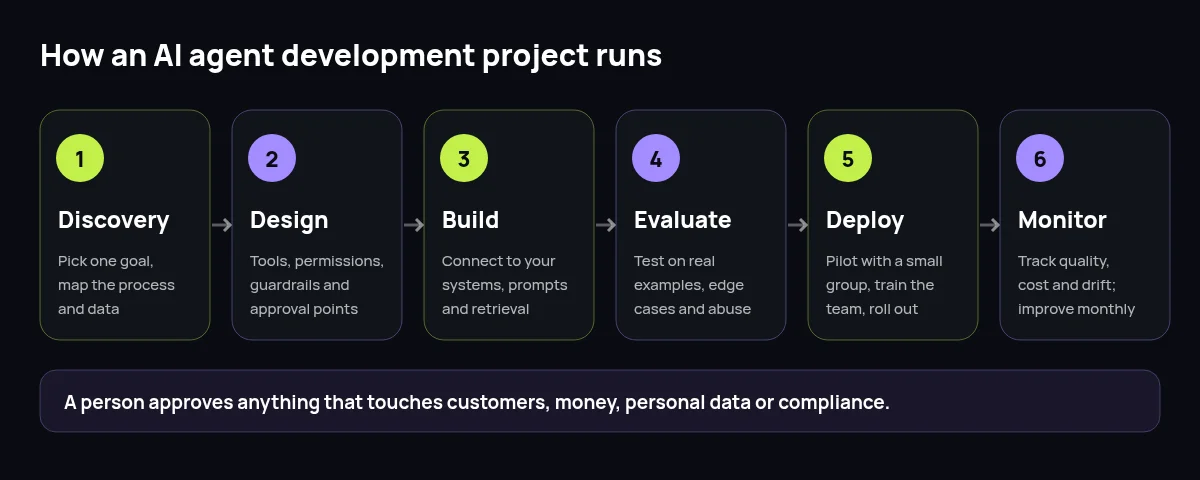
- Discovery. We pick one goal with clear volume and a clear success measure, map the current process with the people who do it, and check which data and systems the agent will need. You get a short written scope, including what the agent will not do.
- Design. We define the agent's tools, the minimum permissions it needs, its escalation rules and the approval points. We also choose the model and architecture: a single agent, an agent inside a fixed workflow, or several cooperating agents.
- Build. We connect the agent to your systems, prepare the knowledge it retrieves from, write and version the prompts, and add logging from day one.
- Evaluation and testing. Before launch we run the agent against a test set drawn from your real history, including awkward cases, missing data and attempts to misuse it. We measure accuracy, escalation behaviour and cost per task, and fix what fails.
- Deploy. We launch as a pilot with a small group, often in draft-only mode first, train the team and write the documentation. Every agent has a simple way to switch it off.
- Monitor and improve. Models, prices and APIs change often. We review logs, user feedback, quality scores and spend, then improve the agent and add tasks when the first one is stable.
Evaluation is the step most teams skip, and the reason many agent pilots stall. An agent that works in a demo but fails on one case in ten is not ready for customers. Measuring it on real examples is what turns a promising prototype into something your team can trust.
Tools and integrations we work with
We are tool-agnostic and choose what fits your stack, data rules and budget. These are tools we regularly work with; we are not resellers, and the list is not a set of partnerships.
- Models: models from providers such as OpenAI, Anthropic and Google, and open-weight models where data must stay in your own environment.
- Agent frameworks and protocols: function and tool calling, frameworks such as LangGraph and the OpenAI Agents SDK, and the Model Context Protocol (MCP) for connecting tools.
- Retrieval: vector search in Postgres with pgvector or managed vector databases, plus search over your existing help center and document stores.
- Automation platforms: n8n, Make and Zapier for the fixed steps around an agent.
- Business systems: Shopify and Shopify Plus, BigCommerce, HubSpot, Salesforce, Gorgias, Zendesk, Intercom, NetSuite, Slack, Google Workspace and Microsoft 365.
- Custom code and APIs where no platform reaches a system, or where volume, latency or data rules call for it.
Guardrails, privacy and human-in-the-loop
An agent that can act needs stronger controls than one that only talks. We design them in from the first workshop:
- Least-privilege access. Each agent gets only the tools and data it needs, through separate credentials you control and can revoke.
- Human-in-the-loop. A person approves refunds, price or stock changes, outbound messages to new contacts, anything involving personal data and anything else that is hard to undo.
- Privacy law. We design for Canada's PIPEDA and Quebec's Law 25, which requires telling people when a decision about them is made only by automated processing, and for the GDPR when you serve people in Europe, including its rules on automated decision-making.
- EU AI Act transparency. When people talk to an agent, they are told they are interacting with AI, and AI-generated content is labelled where the rules require it.
- Data handling. We use business or enterprise settings that exclude your inputs from model training where providers offer them, limit what is sent to models and set retention periods.
- Logging and audit. Every tool call and decision is logged, so you can see what the agent read, what it did and why.
- Safety testing. We test against prompt injection, off-topic requests and attempts to extract data before launch, and keep testing after it.
This is engineering practice, not legal advice. Your legal and privacy team keeps final sign-off.
What affects the cost of AI agent development
We do not publish a price list, because two agent projects rarely have the same scope. These are the factors that drive the effort and the running cost:
- Task complexity. One narrow task with clear rules costs far less to build and test than an agent that plans across many steps.
- Number of integrations. Each system the agent reads from or writes to adds design, security and testing work, especially older systems without good APIs.
- Data readiness. Clean, current help content and records speed things up; scattered or outdated knowledge needs work first.
- Risk level and approvals. Customer-facing, financial or regulated tasks need more evaluation, review steps and logging.
- Evaluation depth. Larger test sets and red-team testing take time, and pay for themselves in fewer failures later.
- Model and usage. Model choice and monthly task volume drive the ongoing usage cost, which we estimate and track for you.
- Hosting and security requirements. Running in your own cloud, single sign-on or a formal security review add scope.
- Support after launch. Monitoring, updates and new tasks are planned as ongoing work.
We start with discovery and then give a fixed scope and quote for the first agent, so you see value before expanding.
How to choose an AI agent development company
- Do they start from your process? Ask how they choose use cases, and what they would advise you not to build.
- Can they integrate? An agent that cannot read your orders or update your CRM is a demo. Ask which systems they have connected and how.
- How do they evaluate? Ask to see the test set and the measures they will use before launch.
- Where are the human checkpoints? They should be named in the design, not added after an incident.
- How do they handle privacy and security? Ask about PIPEDA, Law 25, GDPR, permissions, data retention and which providers see your data.
- Are they tool-agnostic? Be careful if every answer is the same platform or model.
- Who owns the work? You should own the prompts, code, configuration and documentation, in accounts you control.
- What happens after launch? Ask who monitors quality and cost and how changes are made.
- Are they honest about results? Notice whether they separate measured AI results from other project work.
For a local view, see our guide on how to choose an AI agency in Toronto.
Why work with Startup Slang on AI agents
- Builders, not just advisers. We design, code, integrate and host.
- Commerce and systems depth. Years of Shopify, BigCommerce and custom development work mean we know the systems agents need to plug into, because we have built them.
- Marketing and development in one team, so agents connect to growth goals, not just to IT tickets.
- Bilingual delivery in English and French, from Toronto and Montreal, for clients across Canada, the US and Western Europe.
- Honest reporting. Our case studies are development, e-commerce and content work, not AI agent results. We will publish AI agent results only when they are measured and the client agrees.
- Verified reviews: 5.0 on Clutch from 5 reviews.
Want the wider picture first? See our AI automation agency page or all AI services.