
Magento has powered large, complex online stores for years. Today it comes in two forms: Magento Open Source, the free code base you host yourself, and Adobe Commerce, the licensed edition Adobe sells with extra features, support and cloud hosting. Shopify is the hosted commerce platform most independent brands now start on, with Shopify Plus as its enterprise plan. Both can run a serious business. They ask very different things of your budget and your team.
This comparison covers what each platform really costs to own, the difference between Magento Open Source and Adobe Commerce, Shopify's plans versus Shopify Plus, B2B, extensions and apps, performance, security and patching, the team you need, and when each one is the better fit. Facts come from Adobe's lifecycle policy, pricing page and documentation and from Shopify's US and Canadian pricing pages and Help Center, all checked on November 12, 2026. Prices are in US dollars unless marked CAD.
The short answer
Pick Magento or Adobe Commerce if your business depends on deep custom logic in the platform itself, you have (or want to fund) a strong development team, you need full control of the code and hosting, or you already rely on Adobe Commerce's B2B module for quoting and purchase approvals. Pick Shopify if you would rather spend your budget on growth than on servers, upgrades and patches, you want to launch features with apps instead of custom builds, and you want one platform for direct-to-consumer and wholesale. For most brands we talk to, Shopify or Shopify Plus costs less to run and moves faster. Magento still wins for some heavily customized stores.
Shopify vs Magento at a glance
| Comparison | Magento Open Source / Adobe Commerce | Shopify / Shopify Plus |
|---|---|---|
| Owner | Adobe | Shopify Inc. |
| Software cost | Open Source: free (OSL 3.0 licence). Adobe Commerce: licence quoted by Adobe, no public price | Basic $29/mo billed yearly ($39 monthly); Grow $89; Advanced $359; Plus from $2,300/mo |
| Hosting | You host Open Source and on-premises Adobe Commerce. Adobe hosts Adobe Commerce on Cloud (single-tenant) and Adobe Commerce as a Cloud Service (multi-tenant) | Included: unlimited web hosting and free SSL on every plan |
| Upgrades and patches | You apply them, except on Adobe Commerce as a Cloud Service, where Adobe deploys them automatically | Handled by Shopify |
| Native B2B | Adobe Commerce B2B module (separate licence). Not in Open Source | All plans from Basic up (3 active catalogs; unlimited on Plus) |
| Customization | Full access to PHP code, database and hosting stack | Liquid themes, apps, APIs and Shopify Functions; full checkout customization on Plus |
| Extensions | Adobe Commerce Marketplace and third-party modules, installed in your code base | Shopify App Store, apps run outside your theme code |
| Multi-store | Multiple websites, stores and store views from one installation | Markets on every plan; Plus adds up to 9 free expansion stores |
| PCI compliance | Your responsibility on self-hosted setups; Adobe-hosted options are PCI certified | Shopify is certified Level 1 PCI DSS and covers every store by default |
| Default URLs | Configurable, often /product-name.html and /category/product-name.html | /products/handle, /collections/handle |
Magento Open Source vs Adobe Commerce
"Magento" now means one of four things, and the cost and the workload change with each one:
- Magento Open Source. The free code base, published under the Open Software License 3.0. You choose the host, install it, and own every upgrade, patch and extension conflict.
- Adobe Commerce on-premises. The licensed edition with Adobe-only features such as the B2B module, content staging and customer segments, running on infrastructure you manage.
- Adobe Commerce on Cloud. Adobe calls this its PaaS option: a single-tenant, dedicated cloud infrastructure that Adobe hosts, while your team still builds, deploys and upgrades the application.
- Adobe Commerce as a Cloud Service. Adobe's SaaS option, a multi-tenant service with automatic feature and security updates. Adobe's lifecycle page calls it the recommended long-term destination for Adobe Commerce on Cloud customers.
Adobe does not publish Adobe Commerce prices. Its pricing page asks you to request customized pricing, and its Adobe Commerce on Cloud product description defines the licence around tiers of gross merchandise value (GMV) and average order value. In practice the licence grows as your sales grow, and you will only know your number after a sales conversation. Treat any figure you read online as an estimate, not a price.
Shopify plans vs Shopify Plus
Shopify publishes its prices. These are the figures on Shopify's US pricing page and Canadian pricing page on November 12, 2026:
| Plan | US price (yearly / monthly) | Canada (CAD, yearly) | Online card rate (US) | Third-party payment fee | Staff accounts |
|---|---|---|---|---|---|
| Basic | $29 / $39 per month | $37 | 2.9% + 30¢ | 2% | No extra staff accounts |
| Grow | $89 / $105 per month | $99 | 2.7% + 30¢ | 1% | 5 |
| Advanced | $359 / $399 per month | $389 | 2.5% + 30¢ | 0.6% | 15 |
| Plus | From $2,300 per month | From $3,400 | 2.25% + 30¢ | 0.2% | Unlimited |
Card rates apply when you use Shopify Payments. The third-party fee only applies if you use another payment provider. Plus adds things a Magento-sized business usually cares about: full checkout customization, up to 10x API rate limits on select APIs, up to 25 headless storefronts, up to 9 free expansion stores, unlimited B2B catalogs, Plus Certified apps and priority support. Plus offers 1-year and 3-year subscription terms. Our Shopify vs Shopify Plus guide covers when the upgrade pays off.
Hosting and total cost of ownership
Plan prices are the smallest part of this comparison. The honest way to compare is a three-year total cost of ownership with the same lines on both sides.
On Magento Open Source, the software is free but almost everything around it is not: hosting sized for your peak traffic, a CDN, the services the platform depends on (Adobe tests 2.4.9 with PHP 8.5, OpenSearch 3, MariaDB, RabbitMQ, Valkey and nginx), a payment gateway, paid extensions and their yearly renewals, monitoring, backups, PCI compliance work, and a developer or agency retainer for patches and upgrades. On Adobe Commerce, add the licence, plus hosting if you run it yourself.
On Shopify, the plan includes hosting, SSL, checkout and PCI compliance. Your extra lines are app subscriptions, a theme, payment fees and agency or developer time for custom work. Apps can add up, so list the ones you will really need before you compare.
Do not forget the cost of change itself. A Magento minor-version upgrade is usually a project with testing across every extension. On Shopify, platform updates arrive without an upgrade project, so the budget goes into new features instead.
B2B and wholesale
This is where the comparison changed most in 2026. On April 2, 2026, Shopify made key B2B features available on the Basic, Grow and Advanced plans at no extra cost. According to Shopify's B2B features by plan, every plan from Basic up gets company profiles and locations, net payment terms, quantity rules and price breaks, vaulted cards, draft-order invoicing, PO numbers and up to 3 active catalog assignments across B2B markets. Plus adds unlimited catalogs, catalogs assigned directly to a company location, deposits and partial payments.
Adobe Commerce's B2B module is broader out of the box, with company hierarchies, shared catalogs, negotiable quotes, requisition lists, quick order and purchase order approvals. Adobe lists it as "Adobe Commerce only" with a separate licence. Magento Open Source has customer groups, tier pricing and a purchase order payment method, and stores add the rest with extensions. If negotiated quotes and multi-step approvals are central to how you sell, weigh that carefully. If you mostly need trade pricing, terms and fast reorders, Shopify now covers it on every plan. Our Shopify B2B guide goes deeper.
Extensions vs apps
Magento extensions are PHP modules installed into your code base. That gives them deep access, which is powerful, but it also means two extensions can conflict, an upgrade can break one, and every module adds to the testing you do before each patch. Shopify apps mostly run on the app developer's infrastructure and connect through Shopify's APIs and theme app extensions, so installing or removing one rarely touches the core of your store. The trade-off is control: on Shopify you work within what the APIs and Shopify Functions allow, while on Magento you can change almost anything if you are willing to maintain it.
Performance and scaling
Magento can be very fast, but only when it is tuned: full-page caching with Varnish, a search engine, caching layers, a CDN, image optimization and hosting sized for your biggest sale. Performance is your team's job, and it can slip after extension installs or traffic spikes. Shopify runs every store on its own hosting and global infrastructure, so there is no server to size for Black Friday. Theme code and app scripts still decide how fast your pages feel on Shopify, so a slow theme is still a slow store.
Security and patching
Adobe gives each Adobe Commerce 2.4.x release three years of standard support from its release date. These dates come from Adobe's lifecycle policy (last updated September 18, 2026):
| Release | Released | Standard support ends | Extended support ends (Adobe Commerce) |
|---|---|---|---|
| 2.4.9 | May 12, 2026 | May 31, 2029 | To be announced |
| 2.4.8 | April 8, 2025 | May 31, 2028 | To be announced |
| 2.4.7 | April 9, 2024 | May 31, 2027 | May 31, 2028 |
| 2.4.6 | March 14, 2023 | August 11, 2026 | August 31, 2027 |
| 2.4.5 | August 9, 2022 | August 12, 2025 | August 11, 2026 |
| 2.4.4 | April 12, 2022 | April 12, 2025 | April 14, 2026 |
Three details matter. First, Adobe's release policy says extended support security patches are for Adobe Commerce customers only and are not available for the Magento Open Source code base. Second, from June 1, 2027, Adobe says it will no longer maintain Adobe Commerce on Cloud environments running unsupported versions and may suspend their traffic. Third, PHP has its own clock: Adobe notes that PHP 8.1 reached end of life on December 31, 2025 and PHP 8.2 reaches it on December 31, 2026, which puts PCI compliance at risk for stores still running them.
On Shopify there is no version to track. Shopify is certified Level 1 PCI DSS compliant, and that covers every store's storefront, cart and hosting by default. You are still responsible for staff access, apps you install and any custom code, but patching the platform is not on your list.
Development resourcing
Magento needs specialist PHP developers who know its module system, indexers, caching and deployment process, and the work never stops: patches, minor upgrades, PHP and service upgrades, and extension updates. Many Magento merchants pay an agency retainer or keep an in-house team mainly to stay current. Shopify development uses Liquid for themes and Shopify's APIs and Functions for custom logic. A small team, or an agency, can run a large Shopify store because the platform work is done for you. If your developers mostly maintain Magento instead of shipping features, that is the strongest sign Shopify will save money.
When to choose each one
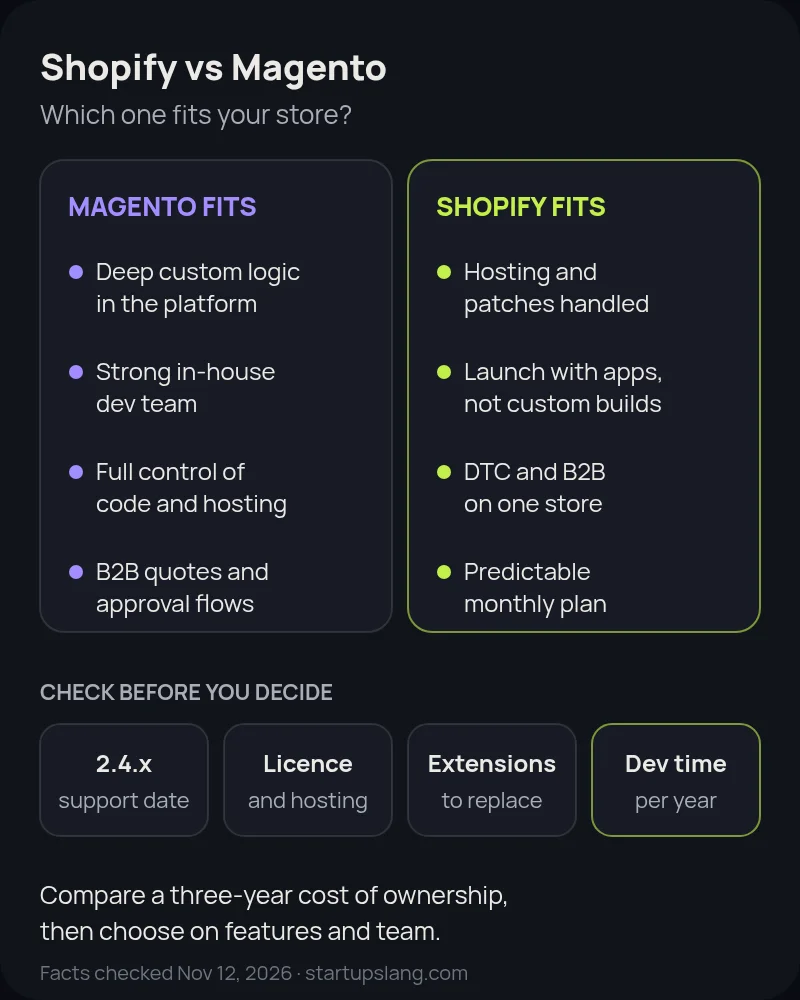
Stay on Magento or Adobe Commerce if your pricing, catalogue or order logic lives in custom platform code that would be hard to rebuild with apps and Shopify Functions, you have a capable in-house team that is upgrading on schedule, you need full control of where and how your store is hosted, or Adobe Commerce B2B quoting and approval flows run your wholesale business.
Choose Shopify if your team spends more time keeping Magento current than improving the store, you are on 2.4.6 or older and facing an upgrade project anyway, you want a predictable monthly platform cost, or you want direct-to-consumer and wholesale on one store with B2B included in your plan. Choose Shopify Plus when you need checkout customization, unlimited B2B catalogs, expansion stores or higher API limits.
If you decide to switch
Shopify's free Store Migration app does not support Magento, so moves use a third-party migration app, Shopify's CSV imports or custom scripts. The work that protects revenue is the same either way: map configurable products to Shopify variants, replace each extension with an app or a Shopify feature, move customers and orders, and redirect every old URL, including .html product URLs and store view paths. Our Magento to Shopify migration guide walks through each step. We have done it for brands such as Holigos, which we moved from Magento to Shopify Plus.
How Startup Slang helps
We help brands choose a platform and then build, migrate and grow on it. If you are weighing Magento against Shopify, we will price your real three-year cost on both, list the extensions and custom code you would need to replace, and give you a straight answer. Comparing other platforms too? See our Shopify vs BigCommerce and Shopify vs WooCommerce comparisons. If Shopify is the right call, our Shopify migration team handles data, redirects, theme and apps from Toronto and Montreal, and our Shopify agency team takes it from there.
Frequently asked questions
Is Shopify better than Magento?
For most brands, yes: Shopify handles hosting, security patches, PCI compliance and checkout updates, so your budget goes into growth instead of upgrades, and apps replace most custom builds. Magento or Adobe Commerce can be the better choice when your business depends on deep custom logic in the platform, you have a strong in-house development team, or you rely on Adobe Commerce's B2B quoting and approval features.
Is Magento free?
Magento Open Source is free to download and use under the Open Software License 3.0, but you pay for hosting, the services it runs on, extensions, security and development time. Adobe Commerce, the licensed edition, is not free: Adobe quotes the licence privately.
How much does Adobe Commerce cost?
Adobe does not publish a price. Its pricing page asks you to request customized pricing, and its Adobe Commerce on Cloud product description ties the licence to tiers of gross merchandise value and average order value. Hosting (if you self-host), extensions and development are extra. Shopify Plus starts at $2,300 a month in the US and from $3,400 CAD in Canada.
Does Shopify support B2B like Magento?
Since April 2, 2026, Shopify B2B is available on the Basic, Grow and Advanced plans at no extra cost, with company profiles, net payment terms, quantity rules, price breaks and up to 3 active catalog assignments. Shopify Plus adds unlimited catalogs, direct company catalogs, deposits and partial payments. Adobe Commerce's B2B module adds negotiable quotes, requisition lists and purchase order approvals, but needs a separate licence and is not part of Magento Open Source.
Is Magento end of life?
No. Adobe released Adobe Commerce 2.4.9 on May 12, 2026, with standard support until May 31, 2029. Older release lines are ending, though: 2.4.6 left standard support on August 11, 2026, and Adobe says extended support security patches are for Adobe Commerce customers only, not Magento Open Source.
Which is better for SEO, Shopify or Magento?
Both handle the essentials: editable titles and meta descriptions, canonical tags, alt text, sitemaps and redirects. Magento gives more control over URLs; Shopify uses fixed /products/ and /collections/ paths. Content, page speed and site structure matter more than the platform. When you switch, every old Magento URL needs a 301 redirect to its new Shopify URL.
Can I migrate from Magento to Shopify?
Yes. Shopify's free Store Migration app does not support Magento, so stores move with a third-party migration app, Shopify's CSV imports or custom scripts against the Magento API. Our Magento to Shopify migration guide covers each step, from product mapping to redirects.