More of your buyers now get their first answer from a machine. Google shows AI Overviews and AI Mode responses above or instead of the classic list of links, and people ask ChatGPT, Perplexity, Gemini and Copilot to compare suppliers, explain a product category or recommend a shortlist. Those answers are built from web pages the systems can crawl, understand and trust. If your pages are hard to read, vague about what you sell or missing from the sources those systems lean on, your brand is simply not in the answer.
Startup Slang is an AI-first agency for marketing and development, founded in 2017 and based in Toronto and Montreal. As an AI SEO agency, we help brands in Canada, the United States and Western Europe stay findable in classic search and visible in AI-generated answers. We treat generative engine optimization (GEO), answer engine optimization (AEO) and LLM SEO as methods inside one engagement, built on the technical SEO, content and structured-data work that search engines have always rewarded.
This page explains what AI SEO, GEO, AEO and LLM SEO mean, what our AI SEO services cover, how a project runs, how we approach e-commerce and B2B brands, what we will not promise, what affects the cost and how to choose an AI SEO company. If you want the educational version first, read our guide to AI SEO and answer engine optimization. This service is part of our AI services.
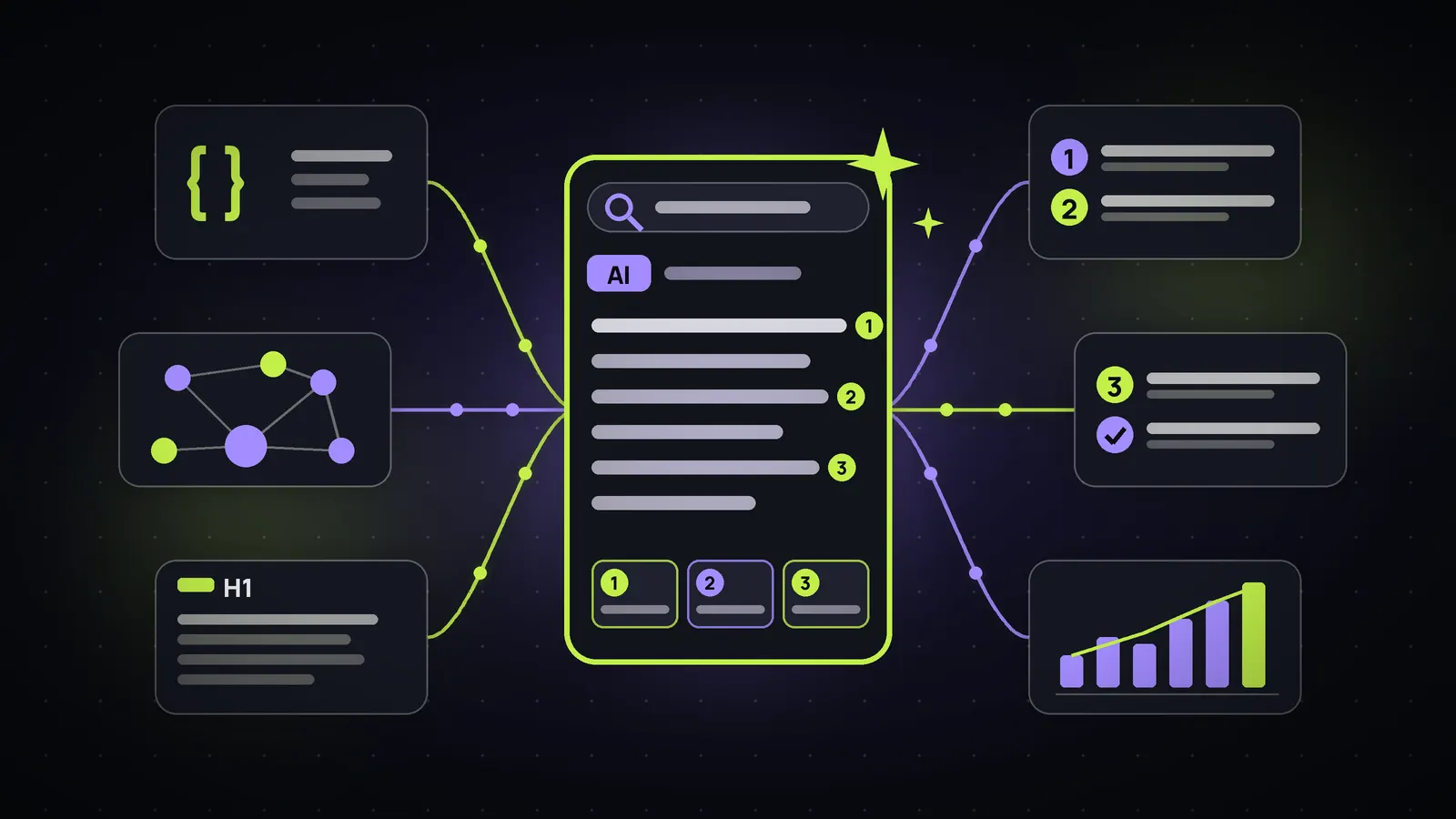
What AI SEO, GEO, AEO and LLM SEO mean
AI SEO is the work of making a brand visible wherever search now happens: the classic Google and Bing results, Google AI Overviews and AI Mode, and AI assistants that search the web before they answer. The phrase is also used for "using AI tools to do SEO". We do use AI in our own workflow, for research, clustering and first drafts reviewed by people, but when buyers search for an AI SEO agency they usually want the first meaning: show up in AI answers.
Several names describe overlapping parts of the same job. They are worth separating, because agencies use them loosely:
| Term | What it focuses on | Where it shows up |
|---|---|---|
| SEO | Crawlable, indexable, useful pages that rank for the queries your buyers type. | Google and Bing results, and the index AI features draw from. |
| AEO (answer engine optimization) | Pages that answer specific questions directly, with clear headings, short answers and FAQs that match the visible text. | Featured snippets, AI Overviews, voice assistants, chat answers. |
| GEO (generative engine optimization) | Content, entities and third-party citations shaped so generative engines can understand, quote and attribute your brand. | ChatGPT search, Perplexity, Gemini, Copilot, Google AI Mode. |
| LLM SEO | An older, broader label for the same goal: being represented accurately by large language models. | Answers from any LLM-based assistant. |
In practice, they share one foundation. Google says in its guidance on AI features and your website that the best practices for SEO remain relevant for AI Overviews and AI Mode, and that there are no additional requirements or special optimizations needed to appear in them. A page must be indexed and eligible to show with a snippet to be used as a supporting link. That is why we never sell GEO as a trick layered on top of a weak site. The work starts with the fundamentals, then adds the things that make a page easier to quote.
What our AI SEO services cover
Every engagement is scoped to your site, your market and the questions your buyers ask, but the work usually falls into seven areas.
1. Technical foundation and AI crawler access
If a crawler cannot reach or render your content, nothing else matters. We audit indexing, internal links, canonical tags, page speed and rendering, and we check that important content is available as text rather than locked inside images or scripts. We also review your robots.txt and firewall or CDN rules for the crawlers that feed AI answers. OpenAI documents that sites which opt out of OAI-SearchBot will not be shown in ChatGPT search answers, and Perplexity recommends allowing PerplexityBot to appear in its results. Training crawlers such as GPTBot, and the Google-Extended token, are separate choices. We explain the trade-offs so you can decide what to allow; we do not make that call for you.
2. Entity and structured-data work
AI systems need to know who you are, what you sell and where you operate, and they need that story to be consistent. We align your organization details, service and product names, locations and people across your site and the profiles you control, and we add or repair schema.org markup (Organization, Service, Product, FAQPage, Article, BreadcrumbList and others where they fit). Google is clear that no special structured data is required for AI features, and that structured data must match the visible text. We use markup to remove ambiguity, not as a shortcut.
3. Content structured for citation
Answer engines favour pages that state the answer early and back it up. We restructure key service, category and product pages so they say plainly what you offer, who it is for and how it works in the first lines, use headings that mirror real buyer questions, include comparison tables, definitions, steps and FAQs, and cite sources for any statistic. Where you have gaps, we write new guides and comparisons with people reviewing every draft. We avoid mass-produced pages: Google's spam policies treat scaled content abuse as a violation whether the pages are written by people or by AI.
4. Digital PR, citations and brand mentions
Generative engines often cite reviews, directories, industry publications, comparison articles and community discussions rather than your own site. We map which third-party sources appear in answers for your category, then work to earn accurate listings and mentions there through white-hat outreach: useful guest articles, expert commentary, data you can share, correct directory profiles and partner pages. No paid link schemes, link swaps or fake reviews.
5. Google AI Overviews and AI Mode
For Google, the work is SEO done thoroughly: pages that are indexed and eligible for snippets, helpful content that answers the follow-up questions AI Mode tends to explore, correct Merchant Center and Business Profile data where relevant, and internal links that make your best pages easy to find. Google describes a "query fan-out" technique in which AI features run several related searches to build a response, so we cover the sub-questions around your main topic, not only the head term.
6. ChatGPT, Perplexity, Gemini and Copilot visibility
We build a set of buyer prompts for your category ("best Shopify agency in Canada", "how to choose a B2B payroll provider", and so on), run them in the main assistants and record which brands and sources are mentioned and cited. That shows where you are missing, where you are described inaccurately and which sources the assistants trust. The fixes then flow back into your pages, your entity data and your PR plan. Answers vary by user, location, wording and model version, so we read the results as trends, never as a fixed ranking.
7. Measurement and reporting
Google includes AI Overviews and AI Mode traffic in the Search Console Performance report under the Web search type, so we track impressions, clicks and queries there alongside analytics, referral traffic from AI assistants, branded search and enquiries. We add a repeatable prompt panel for share of answer and citation tracking. Reports say what changed, what we did and what we will test next, in plain language.
Generative engine optimization (GEO) in depth
As a generative engine optimization agency, we focus on one question: when an AI system writes an answer about your category, can it find, understand and attribute a clear statement from you or about you? The term comes from a 2023 research paper by researchers from Princeton University and IIT Delhi, "GEO: Generative Engine Optimization", published at KDD 2024. In their benchmark, adding elements such as citations, quotations and statistics to source text increased its visibility in generated answers by up to 40%, and the effect varied by domain. That is a lab result on a test set, not a promise for any one website, but it supports what we see in practice: specific, sourced, well-structured content is easier for a model to use.
Our GEO work therefore centres on:
- Quotable statements. Short, self-contained sentences that define your offer, your differences and your proof, so a model can lift them accurately.
- Evidence. Original data, clear methods and cited third-party sources instead of unsupported claims.
- Entity clarity. One consistent name, description and set of facts about your brand everywhere it appears.
- Source coverage. Presence in the publications, directories and comparison pages that assistants cite for your category.
- Freshness. Dated, maintained pages, because outdated or conflicting information makes a source harder to trust.
Answer engine optimization (AEO) and LLM SEO
AEO is the question-and-answer side of the same work. We collect the questions buyers ask from sales calls, support tickets, Search Console queries, People Also Ask boxes and assistant prompts, then make sure each important question has a clear, direct answer on the right page. That usually means a concise answer under a question-style heading, followed by detail, examples and a link to the next step. FAQ sections are written for people first, and any FAQPage markup repeats the visible questions and answers word for word.
LLM SEO is the label some buyers still use for this. Whatever you call it, the aim is accurate representation: when someone asks an assistant about your company, the answer should describe what you actually do, for whom and where. Our AI SEO and AEO guide covers the tactics in more depth; this page is about how we deliver them as a service.
How we work: audit to iteration
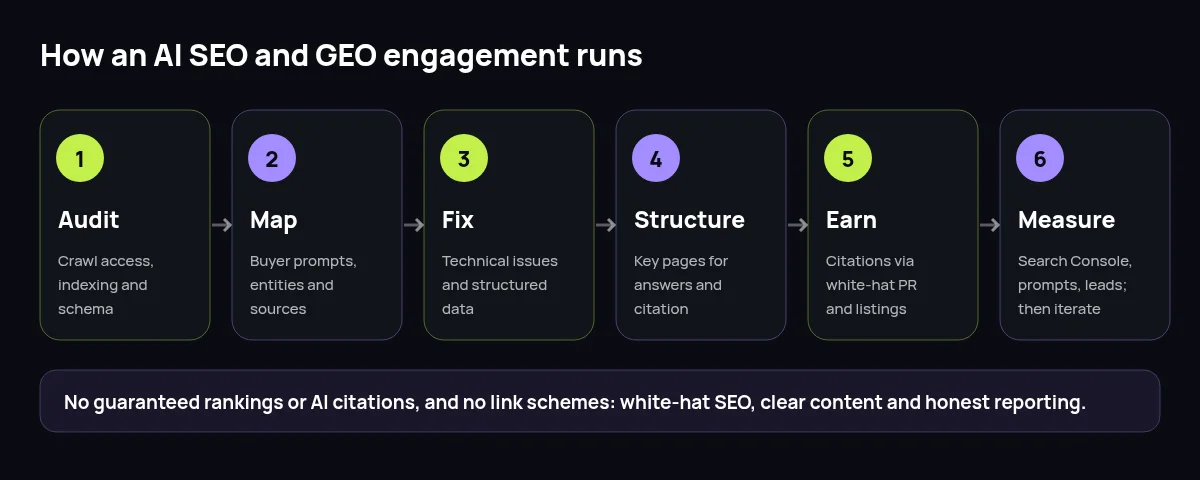
- Audit. We review crawlability, indexing, rendering, robots.txt and CDN rules for search and AI crawlers, page speed, internal links, structured data and the content on your most important pages. We also look at what you already rank for in Search Console.
- Map. We build your list of buyer questions and prompts, the entities that define your brand and category, and the third-party sources that AI answers cite today. We record a baseline of how the main assistants describe you.
- Fix. We prioritise technical and structured-data fixes by impact and effort, and either implement them directly or hand clear tickets to your developers. We work with Shopify, BigCommerce, headless and custom stacks.
- Structure. We rewrite and restructure key service, category and product pages for direct answers and citation, and add the guides, comparisons and FAQs that fill gaps. Subject-matter experts on your side review anything technical or regulated.
- Earn. We run white-hat digital PR and listing work to improve your presence in the sources assistants rely on, and we correct inaccurate profiles.
- Measure and iterate. We report on Search Console, analytics, AI referrals, the prompt panel and enquiries, then pick the next set of pages and sources to improve.
A first audit and roadmap is usually the right starting point. Some clients then keep us on an ongoing basis; others take the roadmap to their in-house team. Both are fine.
AI SEO for e-commerce and Shopify brands
Shoppers now ask assistants which product to buy, how two options compare and where to find something in their size or country. For online stores, AI SEO means:
- Product data that machines can read: complete titles, attributes, sizes, materials, availability and shipping details on the page and in structured data, consistent with your Google Merchant Center feed.
- Category pages that answer buying questions: short guidance on how to choose, comparison tables and FAQs on the pages that already rank, rather than thin blog posts.
- Comparison and "best for" content that is honest about which product fits which buyer.
- Genuine reviews and ratings collected through your platform, never written or incentivised in ways platforms prohibit.
- Technical health on Shopify and headless stacks: duplicate collection URLs, faceted navigation, JavaScript rendering and migrations.
Our e-commerce marketing team handles paid ads, CRO and retention alongside this, and our post on AI for Shopify stores covers the wider picture.
AI SEO for B2B and enterprise
B2B buyers use assistants to build shortlists, explain unfamiliar categories and compare vendors before they ever fill in a form. Buying committees ask different questions: finance asks about cost drivers and contracts, IT asks about security and integrations, and operations asks about rollout. We map those questions to pages, make sure your solution, integration and industry pages answer them clearly, and help you earn coverage in the analyst-style reviews, directories and trade publications assistants tend to cite.
For Canadian brands we can deliver in English and French, and we keep both language versions consistent so assistants do not mix up your offer across markets. For European audiences we pay attention to local terminology and country pages. Where AI SEO overlaps with automation, such as using AI to keep product or knowledge content current, our AI automation agency and AI agent development teams can build the workflow.
What we will not promise
No one controls what Google or an AI assistant shows. Search and AI systems change often, answers differ by user and wording, and Google itself notes that indexing and serving are never guaranteed. So we will not promise rankings, a number of AI citations or a traffic figure. We will promise a clear audit, a prioritised plan, careful implementation, honest reporting and white-hat methods only. Be cautious with any AI SEO company that guarantees placement in ChatGPT or AI Overviews, or that sells special files and markup as a requirement; Google states you do not need new machine-readable files, AI text files or special markup to appear in its AI features.
What affects the cost
We do not publish a price list, because AI SEO engagements vary widely. The main factors are:
- Site size and complexity: the number of templates, products, languages and markets.
- Technical starting point: how much crawling, rendering, migration or structured-data work is needed first.
- Who implements: whether we make changes directly or prepare tickets for your developers.
- Content volume: how many key pages need restructuring and how many new guides or comparisons are needed.
- Digital PR scope: the number of target publications, directories and outreach campaigns.
- Measurement depth: the size of the prompt panel, the number of assistants tracked and the reporting cadence.
- Engagement model: a one-off audit and roadmap, a fixed project or ongoing support.
After a short scoping conversation, we send a written proposal with a fixed scope for the first phase.
How to choose an AI SEO agency
Whether you hire us or someone else, these questions separate solid AI SEO services from hype:
- Do they start with technical SEO and indexing, or jump straight to "AI" tactics?
- Can they explain the difference between search crawlers and AI training crawlers, and the trade-offs of blocking each?
- Do they use structured data that matches your visible content, rather than markup for its own sake?
- How do they measure AI visibility, and do they admit the limits of prompt tracking?
- Do they refuse to guarantee rankings or AI citations?
- Are their link-building and PR methods white-hat, with no paid link networks or fake reviews?
- Will people with real knowledge review AI-assisted content before it is published?
- Can they work with your platform and developers, or will everything become a ticket you have to manage?
- Are their case studies relevant and real, and do they say clearly when they do not have one yet?
Why Startup Slang
We have built and marketed websites since 2017, including Shopify builds, platform migrations and the SEO work that goes with them,. Our team covers development, content and AI automation under one roof in Toronto and Montreal, so technical fixes, content and structured data do not get lost between agencies.
To be direct: we do not yet have published AI SEO or GEO case studies, and we do not present our earlier e-commerce, development or content projects as AI search results. We will publish AI SEO results only once they are measured and the client agrees. Until then, we would rather show you the audit, the plan and the reasoning.
Related services: AI content marketing, AI video ads and AI automation. See all AI services.