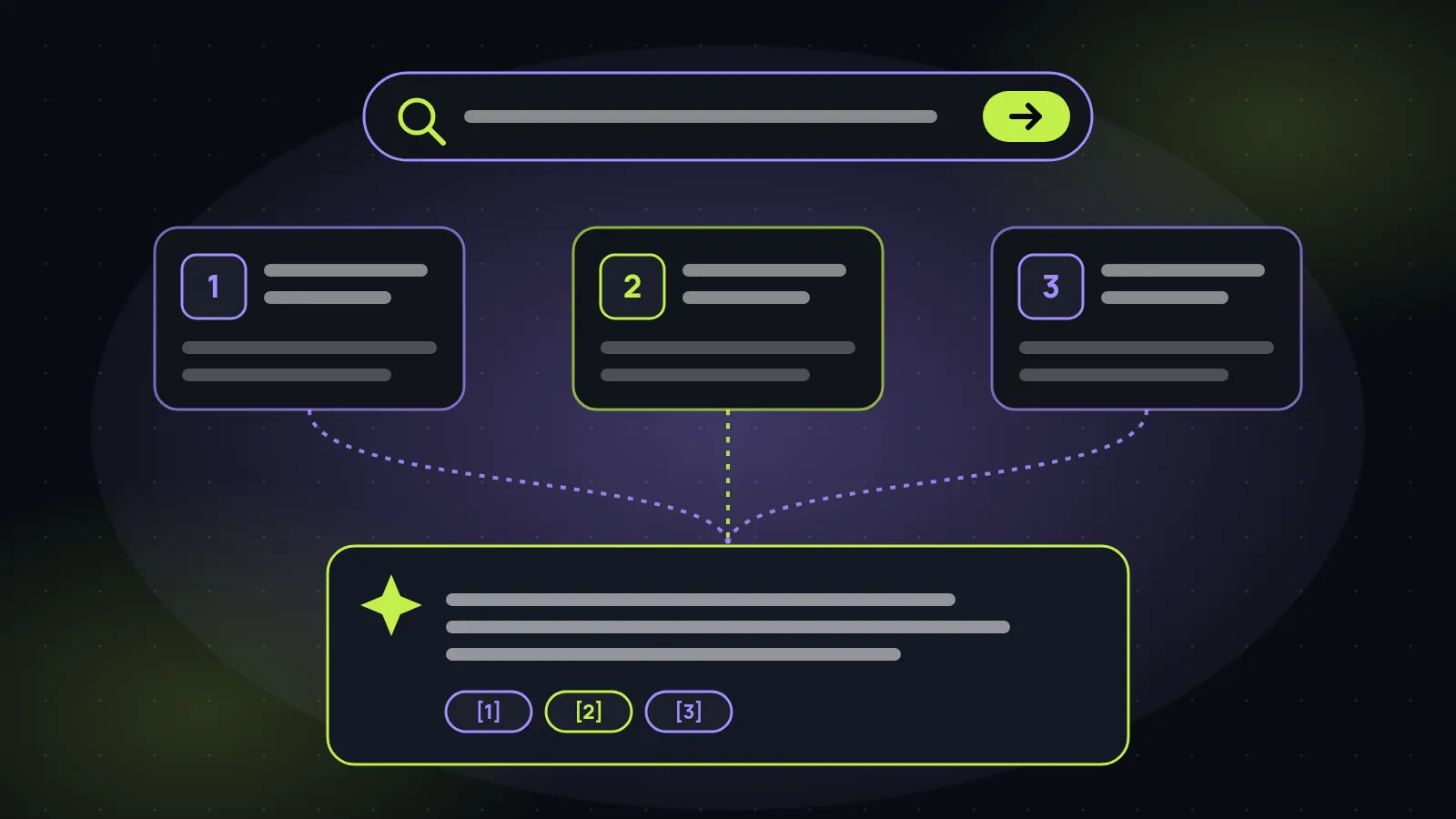
Generative engine optimization (GEO) is the practice of shaping your content, your site and your brand's presence on the web so that AI systems which write answers, such as Google AI Overviews and AI Mode, ChatGPT search and Perplexity, can find your pages, understand them, quote them and cite you as a source. Where traditional SEO asks "how do we rank in the list of links?", GEO asks "when an AI writes the answer, are we one of the sources it uses, and does it describe us correctly?"
This guide is for founders, marketing leads and heads of growth who keep hearing the term and want a straight explanation. It covers where the term comes from, how generative engines pick sources, how GEO compares with SEO and answer engine optimization (AEO), what the research and the platforms actually say, and how to decide whether to do it in-house or hire help. Every external fact below comes from a source we opened and read on 22 November 2026, linked at the end. Where nobody has published a reliable number, we do not use one.
Short version. GEO is not a replacement for SEO. AI answers are built on pages that can be crawled and indexed, so good SEO is the entry ticket. GEO is the extra work that makes a page worth quoting once it has been found.
GEO in one paragraph: where the term comes from
The term comes from a research paper, “GEO: Generative Engine Optimization”, by researchers from Princeton University, IIT Delhi and independent co-authors. It was first posted on arXiv in November 2023 and published in the proceedings of KDD 2024. The authors describe "generative engines" as search systems that gather information from several sources and use large language models to summarize it into one answer. Their concern was simple: website owners have little control over when and how their content appears in those answers, so they proposed GEO as a way to improve a source's visibility inside them.
Since then the word has moved from research into marketing. You will see it next to AEO, "AI SEO" and "LLM SEO". These labels overlap a lot, and most of the work behind them is the same. What matters for a buyer is not the label but the outcome: is your brand present, accurate and cited when a customer asks an AI tool about your category?
How generative engines pick sources
Each engine works differently and the details change often, but most follow the same four broad steps. Knowing them tells you where your content can win or lose.
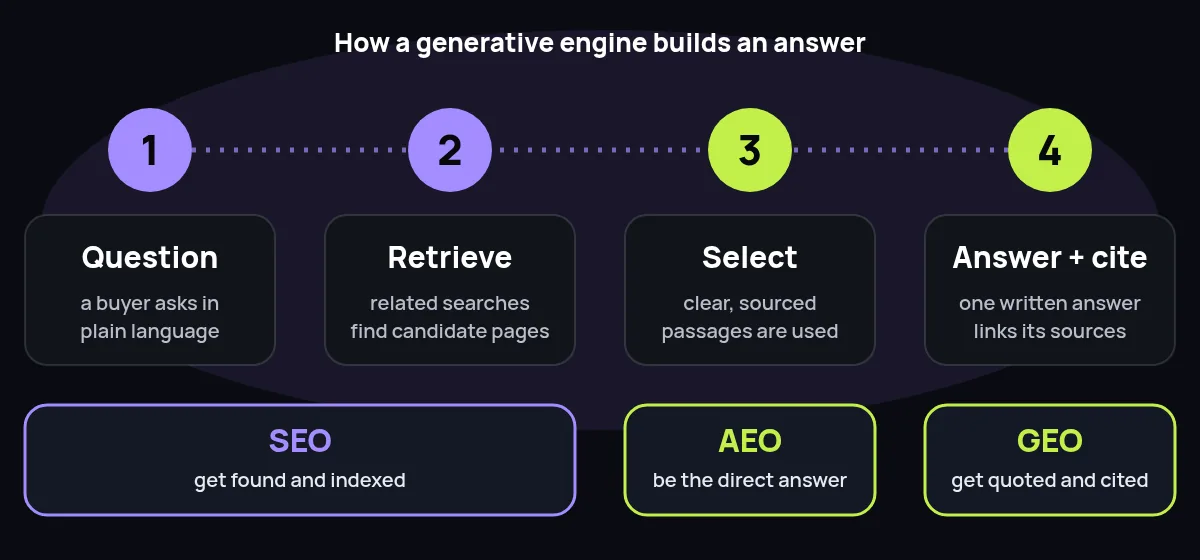
- 1. The question. A person asks something in natural language, often longer and more specific than a classic search, for example "which agencies can help a Shopify brand show up in AI answers?"
- 2. Retrieval. The engine looks for pages that might help. Google says its AI Overviews and AI Mode may use a "query fan-out" technique, issuing several related searches across subtopics and data sources to build a response (Google Search Central). If your page cannot be crawled or indexed, it is out of the running at this step.
- 3. Selection and synthesis. The model reads the retrieved passages and decides which ones are useful, clear and trustworthy enough to use. Vague, padded or contradictory text is easy to skip. A direct, specific sentence is easy to reuse.
- 4. The answer and its citations. The engine writes a single answer and, in many products, links to some of the sources it used. Being cited is the visible win. Being described correctly, even without a click, is the quieter one.
The practical lesson is that SEO mostly helps at step 2, while GEO is about steps 3 and 4. A page can be retrieved and still not be used if a competitor's page says the same thing more clearly, with better evidence.
GEO vs SEO vs AEO: what is actually different
The three are best seen as layers rather than rivals. The table below shows how we separate them when we plan work for a client.
| SEO | AEO | GEO | |
|---|---|---|---|
| Main goal | Rank a page in the list of search results | Be the direct answer to a specific question | Be one of the sources an AI answer is written from, and be cited |
| Where it shows | Classic results pages | Featured snippets, voice assistants, AI answers | Google AI Overviews and AI Mode, ChatGPT search, Perplexity and similar tools |
| What it rewards | Relevance, crawlability, links, page experience | Short, clear answers near the top of a section | Specific, quotable, well-sourced passages from a clearly identified brand |
| Typical work | Technical fixes, keyword research, content, links | Question-led headings, FAQs, structured data | All of the SEO and AEO work, plus citations, original facts, entity consistency and third-party mentions |
| How you measure it | Rankings, clicks, conversions | Snippet and answer appearances | Search Console Web data, AI referrals, a monthly prompt test log, branded search |
If you want a deeper look at the answer-engine side, our guide to AI SEO and answer engine optimization covers question-led content, structured data and an AEO checklist for key pages. This post stays on GEO: the generative step, and what changes when an AI writes the answer instead of listing links.
What the GEO research actually found
The original paper is still the most useful public evidence on what helps, so it is worth reading what it says rather than what is repeated about it. The authors built a benchmark called GEO-bench with 10,000 queries from diverse domains, then rewrote source pages with nine different methods and measured how visible each source was in the generated answers (paper).
- Evidence beats keywords. Adding citations, quotations from relevant sources and statistics gave the strongest gains. The authors report that their methods can boost visibility by up to 40% in generative engine responses.
- Keyword stuffing does not work. Adding more query keywords, the classic SEO shortcut, gave little to no improvement. In their test on Perplexity it did about 10% worse than the unchanged baseline.
- Smaller sites can gain the most. The paper found that lower-ranked websites benefited significantly more from GEO methods than top-ranked ones, which the authors describe as a chance for smaller businesses to compete.
- It depends on the topic. The best method varied by domain, so the authors call for domain-specific approaches rather than one formula.
- It held on a live engine. On Perplexity, quotation addition improved one visibility metric by 22% and the best methods improved another by up to 37%.
Keep the limits in mind. These were controlled experiments, the paper's main tests used GPT-3.5 Turbo, and the authors note that methods may need to change as engines evolve. Treat the findings as direction, not a promise: write specific, sourced, quotable content, and do not expect a fixed uplift on your own site.
What Google says about AI Overviews and AI Mode
Google's Search Central guide on AI features and your website is blunt, and it removes a lot of noise from the GEO conversation:
- There are no additional requirements and no special optimizations needed to appear in AI Overviews or AI Mode. The foundational SEO best practices apply.
- To be shown as a supporting link, a page must be indexed and eligible to show in Search with a snippet. Indexing and serving are not guaranteed.
- Google lists fundamentals that still matter: allowing crawling in robots.txt and at your CDN or host, internal links, page experience, important content in text form, good images and video, structured data that matches the visible text, and up-to-date Merchant Center and Business Profile information.
- You do not need new machine-readable files, AI text files or special schema.org markup to appear in these features.
- Traffic from AI features is included in the Search Console Performance report under the "Web" search type.
Google's spam policies also now name the practice directly: spam includes "attempting to manipulate generative AI responses in Google Search". That is the line to keep in mind when someone sells a GEO trick that sounds too clever. If it would count as cloaking, doorway pages or scaled low-value content in classic search, it is a risk in AI answers too.
AI crawlers and robots.txt: check access first
Many sites block AI crawlers without meaning to, through an old robots.txt rule, a security plug-in or a firewall setting. Before any content work, check who can reach your pages. The main AI search providers document their crawlers publicly:
- OpenAI. According to OpenAI's crawler documentation, OAI-SearchBot is used to surface websites in ChatGPT search, and sites opted out of it will not be shown in ChatGPT search answers, though they can still appear as navigational links. GPTBot is a separate crawler for content that may be used to train OpenAI's models. Each setting is independent, so you can allow search and refuse training. OpenAI says robots.txt changes can take about 24 hours to take effect for search.
- Perplexity. Perplexity's crawler docs describe PerplexityBot as the crawler that surfaces and links websites in Perplexity search results, and say it is not used to crawl content for AI foundation models. A separate agent, Perplexity-User, fetches pages when a user asks a question. Perplexity also explains how to allow its bots through a web application firewall.
- Google. For AI Overviews and AI Mode, the control is the normal Googlebot rules in robots.txt, plus the nosnippet, data-nosnippet, max-snippet and noindex preview controls. Google-Extended is a separate setting for some of Google's other AI systems.
Whether to allow model training is a business decision, not an SEO one. Whether to allow the search crawlers is usually an easy yes if you want to be found.
How to do GEO: a practical checklist
None of this is exotic. It is good SEO and good writing, applied with the generative step in mind. We would work through it in this order:
- Confirm access. Check robots.txt, your CDN and firewall rules for Googlebot, OAI-SearchBot and PerplexityBot, and make sure key pages are indexed in Search Console.
- Answer first. Open each key page and section with a one- or two-sentence answer that could stand on its own if quoted, then explain. Use headings that match how buyers phrase questions.
- Be specific and sourced. Replace vague claims with facts you can back up, and link the source. The research above points to citations, quotations and statistics as the strongest levers. Never invent a number to look quotable.
- Publish things only you know. Your process, your criteria, how you decide, what you will not do. Original detail gives an engine a reason to use your page rather than a summary of ten others.
- Make the entity clear. Use the same company name, description, locations and service list on your site, Google Business Profile, LinkedIn and directories, so engines can tell who you are and what you do.
- Add structured data that matches the page. Organization, Service, Article, Product, FAQPage and BreadcrumbList where they fit. Google says it must match the visible text and is not a special AI requirement, so treat it as clarity, not a hack.
- Earn mentions on other sites. AI answers often draw on reviews, lists, guides and news. Useful guest articles, expert quotes and digital PR on relevant publications help, as long as they are earned and not bought.
- Keep it current. Put a visible "updated" date on pages that change, and refresh facts, examples and links when they move.
For writing at scale without losing quality, our generative AI content strategy guide explains how we use AI in the drafting while keeping people responsible for facts and voice.
How to measure GEO
Measurement is the least mature part of GEO, so be wary of anyone who shows you a single precise "AI visibility score" and nothing else. A sensible set of signals:
- Search Console. Impressions, clicks and queries for your key pages. Google includes AI Overviews and AI Mode traffic in the Web search type of the Performance report.
- AI referrals in analytics. Visits that come from AI assistants, tracked as their own channel so you can see the trend and what those visitors do.
- A fixed prompt test log. A list of 20 to 50 real buyer questions you ask in each major AI tool every month, recording whether your brand appears, how it is described and which sources are cited. Answers vary from run to run, so look at the pattern over months.
- Branded search and direct enquiries. If AI tools mention you more, more people tend to search for you by name. Ask new leads where they first heard of you.
What GEO is not
- Not keyword stuffing. The research found it does little or harm.
- Not a special AI file or secret markup. Google says none is needed for its AI features. Other platforms may differ, so check their documentation rather than a vendor's claim.
- Not cloaking or hidden text for bots. Showing AI crawlers different content from people is a spam risk in Google and an honesty problem everywhere.
- Not buying mentions. Paid links and fake reviews break search engine policies and can damage the trust signals you are trying to build.
- Not a guarantee. Nobody controls what a model writes. Anyone who guarantees citations in ChatGPT or a place in AI Overviews is selling certainty that does not exist.
When to hire a GEO or AI SEO agency, and what to ask
Many teams can start GEO in-house with the checklist above. It makes sense to bring in a marketing agency when one or more of these is true:
- Your buyers already research suppliers in ChatGPT, Perplexity or Google AI Mode, and you are missing from the answers or described wrongly.
- Your site has technical blockers (crawler access, indexing, rendering, structured data) that your team cannot fix quickly.
- You need content, technical SEO and digital PR to move together, and nobody owns all three.
- You sell in more than one market or language, for example English and French in Canada or several countries in Western Europe, and need the brand described consistently across them.
Questions worth asking any GEO or AI SEO agency before you sign:
- How will you measure visibility in AI answers, and what will the monthly report actually show?
- What will you not promise? (A good answer includes "guaranteed citations".)
- How do you stay inside Google's spam policies and the AI platforms' rules, especially for links and mentions?
- Which crawlers and robots.txt rules will you check first, and who approves changes on our site?
- Who writes and fact-checks the content, and how do you use AI in that process?
- What do you need from us: subject experts, approvals, access to Search Console and analytics?
That is how we run our own AI SEO and GEO service: technical access and structured data first, then content built for citation, then earned mentions, with plain reporting and no guarantees we cannot keep. It sits within our wider AI services, alongside AI agents, automation and chatbots.
Sources
Pages we opened and read on 22 November 2026. Platform documentation changes often, so check the current version.
- Aggarwal et al., “GEO: Generative Engine Optimization”, KDD 2024 (arXiv 2311.09735)
- Google Search Central: AI features and your website
- Google Search Central: Spam policies for Google web search
- OpenAI: Overview of OpenAI crawlers
- Perplexity: Perplexity crawlers
Frequently asked questions
What is generative engine optimization (GEO) in simple terms?
GEO is the work of making your content easy for AI systems such as Google AI Overviews, AI Mode, ChatGPT search and Perplexity to find, understand, quote and cite when they write an answer. Traditional SEO aims to rank a page in a list of links. GEO aims to make your page one of the sources an AI answer is built from, and to make sure your brand is described accurately.
Who came up with the term generative engine optimization?
The term was introduced in a research paper titled “GEO: Generative Engine Optimization” by researchers from Princeton University, IIT Delhi and independent co-authors. It was first posted on arXiv in November 2023 and published in the proceedings of KDD 2024, a major data science conference.
Is GEO different from SEO?
Yes, but they overlap heavily. An AI answer can only use pages it can find, so crawling, indexing and the basics of SEO still come first. GEO adds a focus on what happens after a page is retrieved: whether the passage is clear, specific and credible enough to be quoted, and whether the engine can tell who wrote it and why it should be trusted.
What is the difference between GEO and AEO?
The two terms are often used for the same work. Answer engine optimization (AEO) usually describes making content the direct answer to a question, for example in a featured snippet, a voice assistant or an AI answer. GEO is the newer term and focuses on generative engines that combine several sources into one written answer. In practice a good programme covers both.
Does Google require anything special to appear in AI Overviews or AI Mode?
No. Google's Search Central guide on AI features says there are no additional requirements and no special optimizations needed. A page must be indexed and eligible to show in Search with a snippet. Google also says you do not need new machine-readable files, AI text files or special schema.org markup to appear in these features.
Does keyword stuffing help with GEO?
No. In the GEO research paper, keyword stuffing offered little to no improvement in generative engine responses, and in the test on Perplexity it performed about 10% worse than the unchanged baseline. Adding citations, quotations from relevant sources and statistics performed far better in the same tests.
Should I block GPTBot if I want to appear in ChatGPT search?
They are separate controls. OpenAI's crawler documentation says OAI-SearchBot is used to surface websites in ChatGPT search, while GPTBot crawls content that may be used to train its models, and each setting is independent. A site can allow OAI-SearchBot and disallow GPTBot. Decide on training access as a business question, and keep the search crawler allowed if you want to be shown in ChatGPT search answers.
How do you measure GEO results?
There is no single report yet. Google says traffic from AI Overviews and AI Mode is included in the Search Console Performance report under the Web search type. Add AI assistant referrals in your analytics, a fixed list of buyer questions you test in each AI tool every month, and branded search trends. Look at the direction over several months rather than any one answer.
When should a business hire a GEO or AI SEO agency?
When buyers in your market already use AI tools to research suppliers, when AI answers describe your brand wrongly or leave you out, or when you lack the people to fix technical access, structured data and content at the same time. Ask any agency how they measure visibility, what they will not promise and how they stay within search engine spam policies.