Search for d-commerce and you will find three different definitions, a lot of 2022 NFT hype and very little that helps a store owner decide what to do on Monday. This guide fixes that. It explains what d-commerce means, which parts survived the hype, and what a Shopify brand can realistically build with it in 2026.
Short version: the most useful idea in d-commerce is not a token. It is owning the relationship with your customer directly, and using newer payment and ownership tools only where they make buying easier or cheaper.
What is d-commerce?
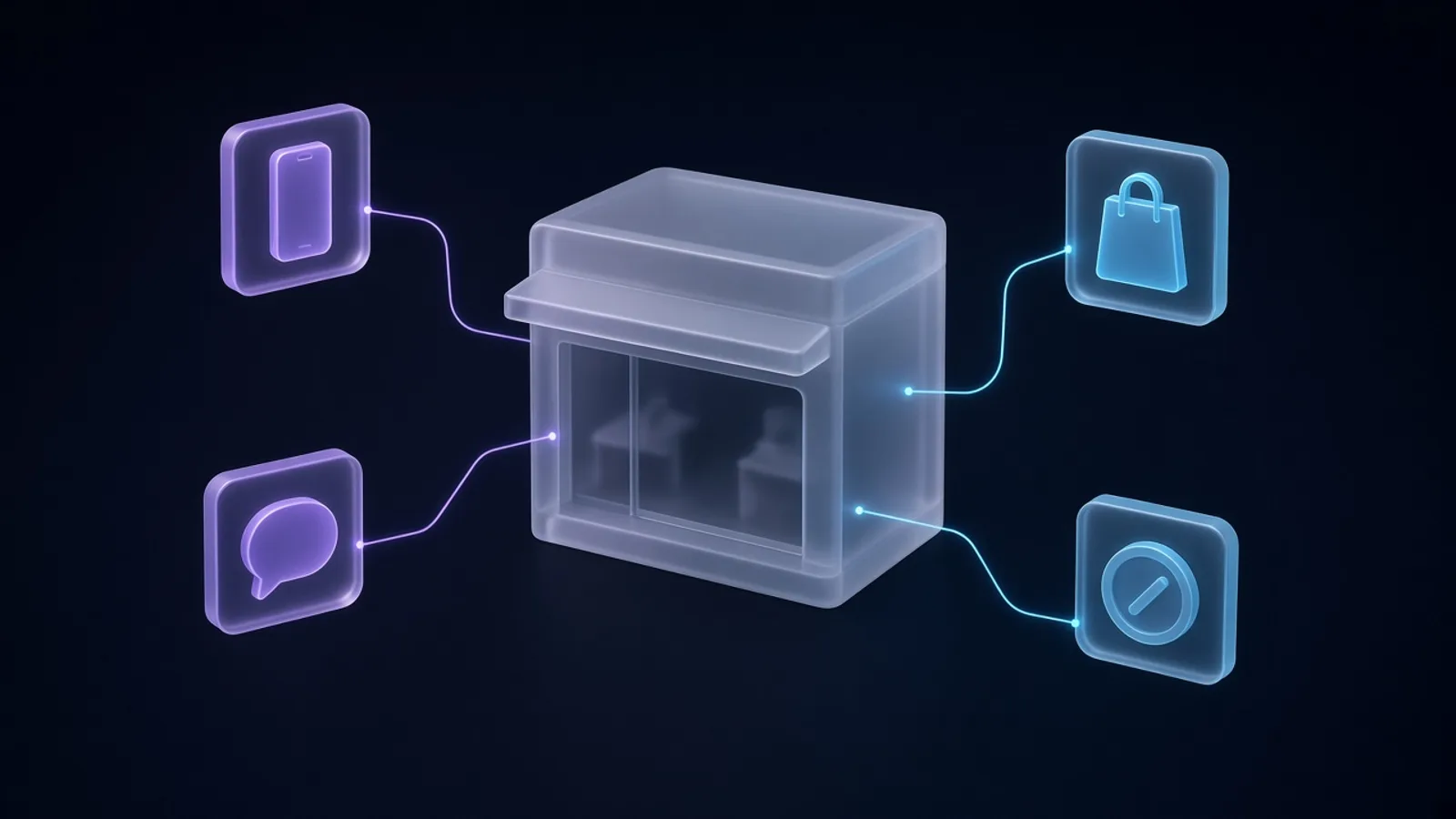
D-commerce usually means decentralized commerce: selling online with fewer middlemen between a brand and its customers, often using blockchain tools. Those tools include crypto and stablecoin payments, tokens that prove membership or ownership, and digital items that live in a customer's wallet rather than in one company's database.
In practice, nobody runs a fully decentralized store. D-commerce features sit on top of a normal store, usually on a platform like Shopify, which still handles the catalog, checkout, taxes, shipping and customer service.
The three meanings of d-commerce
Because the term is loose, it helps to know which version someone is talking about:
- Decentralized commerce. Blockchain-based payments, tokens and digital ownership. This is the meaning behind most of the search interest from 2021 to 2023.
- Direct commerce. Selling direct to the customer (D2C) on your own store instead of through retailers or marketplaces, so you own the data, the margin and the experience.
- Digital commerce. A broad synonym for e-commerce that some analysts and enterprise vendors use, covering every digital sales channel.
For a Shopify brand, the first two matter. Direct commerce is the foundation. Decentralized features are optional layers that only make sense once the foundation works.
Why it matters for Shopify brands in 2026
Three shifts make the useful parts of d-commerce more practical than they were during the NFT boom:
- Payments got simpler. Stablecoins are tied to a currency like the US dollar, so they avoid the price swings that made early crypto checkout unattractive. Payment providers now offer stablecoin acceptance that settles to a brand in regular currency.
- Customer data got more valuable. Rising ad costs and privacy changes push brands to build first-party relationships through email, SMS, loyalty and accounts. That is direct commerce, and it is where most of the return is.
- Buying is spreading beyond the store. Customers now discover and buy through social apps, marketplaces and AI assistants. Owning your product data and customer relationship keeps you in control when the checkout happens somewhere else.
What you can build on Shopify today
These are the d-commerce features we see brands actually use, from most to least common:
- A stronger direct channel. Customer accounts, loyalty, subscriptions, email and SMS flows and a fast mobile store. Native Shopify features and well-known apps cover all of this.
- Crypto and stablecoin checkout. Available through Shopify payment options and third-party crypto payment apps, depending on your country and provider. Most useful for international buyers and tech-forward audiences.
- Token-gated products and perks. Apps from the Shopify App Store can unlock products, discounts or early access for customers who hold a specific token, the same way a loyalty tier would.
- Digital collectibles and proof of ownership. Some brands pair physical products with a digital certificate, which can help with authenticity for limited drops, sneakers, art and luxury goods.
Because each of these is an app or payment setting, you can test one without rebuilding your store, and remove it if it does not earn its place.
Is it worth it? A simple test
Before adding any decentralized feature, answer three questions:
- Have customers asked for it, or does your data show a real segment (for example, international buyers who abandon at payment) that it would help?
- Can you measure it as a normal business metric, such as conversion rate, payment fees, repeat purchase rate or community sign-ups?
- Can your team support it, including refunds, taxes, accounting and customer questions?
If the answer to any of these is no, put the effort into your direct channel first. In our experience, a faster store and better retention beat a novelty feature almost every time.
How to get started: 6 steps
- Audit your direct channel. Check site speed, mobile checkout, account sign-ups and your email and SMS flows. See our Shopify CRO checklist.
- Own your data. Make sure customer, order and product data sits in Shopify and tools you control, not only in a marketplace or ad platform.
- Pick one use case. For example, stablecoin checkout for international orders, or token-gated early access for your most loyal customers.
- Check availability and compliance. Confirm the payment option or app works in your country and on your plan, and talk to your accountant about how crypto payments are recorded and taxed.
- Launch as a test. Run it for a set period with a clear success metric and a rollback plan.
- Keep, grow or remove. If it pays off, build on it. If not, remove the app and keep what you learned.
Common d-commerce mistakes
- Starting with the technology. A token or wallet connection with no clear customer benefit adds friction, not value.
- Making it mandatory. Always keep normal card and wallet checkout. Decentralized options should be extra, never required.
- Ignoring the back office. Refunds, chargebacks, taxes and reporting work differently for crypto payments. Plan them before launch.
- Overpromising value. Do not market digital items as investments. Position them as access, perks or proof of authenticity.
- Adding too many apps. Every app can slow your store. Measure speed before and after.
How Startup Slang helps
We are an AI-first agency with offices in Toronto and Montreal, and we have built on Shopify since 2017. Our Shopify agency team strengthens the direct channel first, with faster stores, better checkout and conversion work, then helps you test new payment, loyalty and ownership features without putting the store at risk. Moving from another platform? Our Shopify migration service protects your data and rankings. Tell us what you are considering and we will tell you honestly whether it is worth building.
Frequently asked questions
What is d-commerce?
D-commerce most often means decentralized commerce: buying and selling with blockchain tools such as crypto or stablecoin payments, tokens and digital ownership, instead of relying only on banks and marketplaces. The term is also used loosely for direct commerce (selling direct to customers) and digital commerce.
Is d-commerce the same as e-commerce?
No. E-commerce is any buying and selling online. D-commerce is a subset of ideas about how that selling works: who holds the customer relationship, how payments settle, and whether customers can own or verify what they bought. Most d-commerce runs on top of a normal e-commerce store.
Can I do d-commerce on Shopify?
Yes, in pieces. Shopify stores already sell direct to customers and own their data. Crypto and stablecoin payments, token-gated products and digital collectibles are added through Shopify payment options and apps from the Shopify App Store. Availability depends on your country, plan and payment provider, so check before you build.
Is d-commerce still worth it after the NFT downturn?
The speculative part faded, but the useful parts stayed: direct customer relationships, lower-cost cross-border payments and verifiable loyalty or ownership. Treat each as a normal business decision with a clear return, not as a trend to chase.
What should a Shopify brand do first?
Start with the direct part: first-party data, email and SMS, loyalty and a fast store. Then test one decentralized feature where customers actually ask for it, such as stablecoin checkout for international buyers or token-gated access for a community.