Phone calls are still where many buyers decide. A patient wants to book this week, a homeowner needs someone to come out tomorrow, a shopper has a question about an order, or a prospect wants to know whether you serve their city. When nobody picks up, most of them do not leave a voicemail. They call the next business on the list.
Startup Slang is an AI-first agency for marketing and development, founded in 2017 and based in Toronto and Montreal. We design, build and run AI voice agents and AI receptionists for businesses in Canada, the United States and Europe. They answer calls when your team cannot, qualify leads, book appointments, follow up with people who asked to hear from you, and hand the conversation to a person whenever a person is the right answer. They speak English and French, and they work inside the CRM, calendar, help desk and phone system you already use.
This page explains what an AI voice agent is, what ours do, how they connect to your tools, how a project runs, what they will not do, which rules on disclosure, recording and outbound calls we design for, and what affects the cost. If you mostly want chat on your website, see our AI chatbot development service. Voice agents are part of our wider AI services.
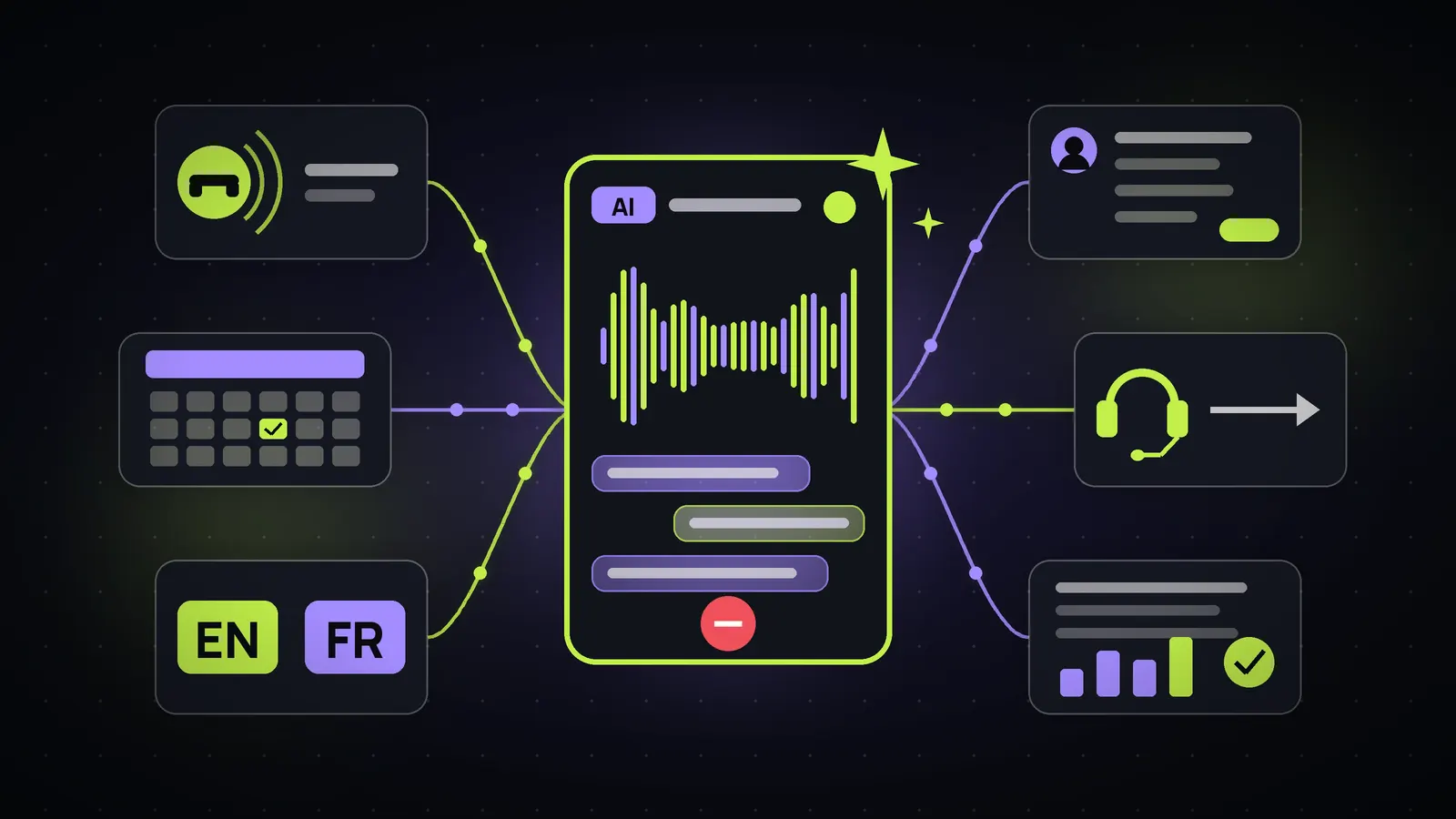
What an AI voice agent and an AI receptionist are
An AI voice agent is software that holds a spoken phone conversation. It listens to the caller, turns speech into text, works out what the caller needs with a large language model, looks things up or takes an action in your systems, and answers in a natural synthetic voice. An AI receptionist is the most common job for a voice agent: answering your main line, greeting callers, answering routine questions, booking or moving appointments, taking messages and routing calls.
The difference from older phone technology is that callers can speak normally. They do not have to press 1 for sales or repeat a keyword. The difference from a person is that the agent follows the rules, scripts and permissions you set, every time, and only knows what you give it access to.
| Option | How callers use it | Best for |
|---|---|---|
| AI voice agent / AI receptionist | Natural conversation; it can look up information, book, qualify and transfer. | After-hours and overflow calls, repeat questions, bookings, first-line qualification. |
| IVR phone menu | Keypad or keyword menus that route the call. | Simple routing when callers already know which department they need. |
| Human answering service | A live operator takes messages from a script. | Calls that need human judgment or empathy from the first second. |
| Website chatbot | Typed chat on your site or in messaging apps. | Visitors who prefer to type; often shares the same knowledge base as the voice agent. |
Many businesses end up with a mix: a voice agent for after-hours and overflow, people for the calls that matter most, and chat on the website. We help you decide where each one fits rather than replacing everything at once.
What our AI voice agents do
Every deployment is scoped to your calls, but the work usually falls into six jobs.
1. Inbound and after-hours answering
The agent answers your main number, a campaign number or overflow calls when every line is busy. It greets callers by your business name, says that it is an AI assistant, answers questions from an approved knowledge base (hours, locations, services, policies, order status where it has access) and keeps the conversation short. After hours it can take a detailed message, book a callback or, for urgent cases you define, transfer to an on-call number.
2. Lead qualification
For sales lines, the agent asks the questions your team would ask first: what the caller needs, where they are, how soon, and how to reach them. It records the answers in your CRM in a consistent format, tags the lead and routes it to the right person or queue. You decide the qualification rules; the agent does not decide who is worth calling back.
3. Appointment booking and rescheduling
Connected to your calendar or booking system, the agent can offer open slots, book, reschedule or cancel appointments and send a confirmation by SMS or email where the caller has agreed to receive one. It respects buffers, service durations, staff availability and location rules, and it does not double-book because it reads the live calendar rather than a copy.
4. Outbound follow-up, with consent
Voice agents can also place calls: a reminder the day before an appointment, a callback to someone who asked to be contacted, or a follow-up to an enquiry form. Outbound calls are where the rules are strictest, so we only set them up for people who have given the right kind of consent, with calling-hour limits, do-not-call checks and an easy way to opt out. More on that in the compliance section below.
5. Escalation and warm transfer to people
A good voice agent knows when to stop. It transfers the call, or books an urgent callback, when the caller asks for a person, when it is not confident in an answer, when the topic is on your escalation list (complaints, billing disputes, legal, medical or safety issues) or when the caller is upset. A warm transfer passes a short summary to your team, so the caller does not have to repeat themselves.
6. Summaries, notes and reporting
After each call, the agent can write a summary, the outcome and the next step into your CRM or help desk, and flag calls for review. You get a dashboard of call volume, reasons for calling, bookings, transfers and unanswered questions. Those unanswered questions are the best input for improving both the agent and your website.
Integrations: CRM, calendar, help desk and telephony
A voice agent that cannot see your systems can only take messages. Most of the value comes from the connections, so we scope them carefully and keep access as narrow as the job allows.
- CRM. Create or update contacts and deals, log call outcomes and summaries, and check whether a caller is an existing customer. We commonly work with HubSpot, Salesforce, Pipedrive, Zoho and Shopify customer data.
- Calendar and booking. Read availability and book into Google Calendar, Microsoft 365 or Outlook calendars and common booking tools, with your rules for buffers and locations.
- Help desk. Open or update tickets with a transcript and summary in tools such as Zendesk, Gorgias, Freshdesk or Help Scout, so phone and email support live in one place.
- Telephony. Keep your existing number and forward calls to the agent on your schedule, or route through a cloud telephony platform such as Twilio or your current provider's SIP trunk. Transfers go back to your desk phones, mobiles or call queue.
- Automation and data. Connect follow-up steps through your automation stack, and send call data to your reporting. Our AI automation agency team builds those workflows.
Tool names here describe software we can connect to, not formal partnerships. We are platform-neutral on the voice side too: we choose the speech, language-model and telephony components that fit your call volume, languages, latency needs and data rules, and we document the choice so you are not locked into us.
AI voice agents in English and French
We run projects from Toronto and Montreal, so bilingual service is a normal requirement for us, not an add-on. A voice agent can greet callers in both languages, switch when the caller does, and use separate approved answers for English and French rather than translating on the fly. We test pronunciation of your brand, product, street and staff names in both languages, and we write French scripts with a French-speaking reviewer. For businesses in Quebec, see our AI agency in Montreal.
How we work: from call map to live agent
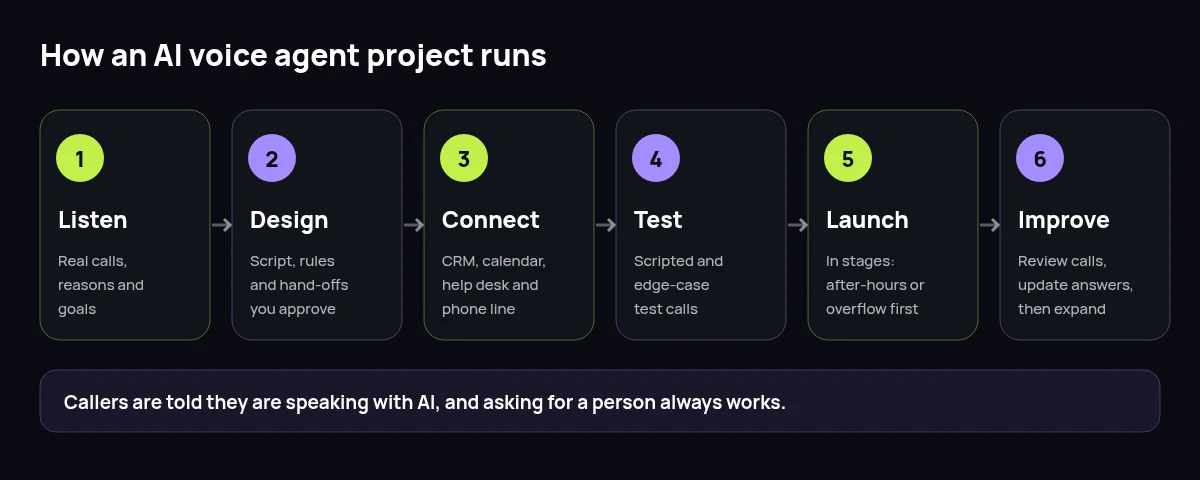
- Listen. We review a sample of real calls or call logs (with your permission and with personal data handled under your privacy policy), group them by reason, and agree on goals: fewer missed calls, faster bookings, cleaner lead data or shorter hold times.
- Design. We write the greeting, the disclosure, the questions, the approved answers and the escalation rules, and we decide what the agent may and may not do in each system. You approve the script before anything is built.
- Connect. We connect the phone line, calendar, CRM and help desk with the narrowest permissions that work, set up call recording and transcription only where you choose to use them, and configure where data is stored and for how long.
- Test. We run scripted test calls for every common reason, then edge cases: accents, background noise, interruptions, wrong information, angry callers, requests for a person and attempts to make the agent go off-script. We fix and re-test until the agent behaves as designed.
- Launch in stages. Most clients start with after-hours or overflow calls, or one location or line, then widen once the reviews look right. Your team gets a short guide to transfers, summaries and the dashboard.
- Review and improve. We review transcripts and outcomes on a schedule, update answers, tighten rules and add new call types. You can keep us on for ongoing improvement or take over with our documentation.
A first deployment is usually one line and a handful of call types. That keeps the risk low and gives you real calls to judge it by before you expand.
What our voice agents will not do
Guardrails are part of the build, not a disclaimer at the end. By default, our AI voice agents:
- Do not pretend to be human. They say they are an AI assistant at the start of the call, and they answer honestly if asked.
- Do not clone a real person's voice without that person's written consent, and we do not imitate staff, celebrities or other brands.
- Do not give medical, legal, financial or safety advice. They take details and route those calls to a qualified person, or tell callers to contact emergency services where that is the right answer.
- Do not take card numbers or other payment details by voice unless the payment step runs through a compliant payment provider that keeps card data away from the agent and the transcript.
- Do not make promises outside your policy, such as refunds, discounts, delivery dates or prices that are not in the approved answers.
- Do not cold-call people who have not given the consent the law requires, or call outside permitted hours.
- Do not trap callers. Asking for a person always works, and so does saying stop or asking to be removed from future calls.
- Do not keep data longer than needed. Recordings and transcripts follow the retention period you set, and access is logged.
Compliance: disclosure, recording consent and outbound calls
Voice agents touch three sets of rules: telling people they are talking to AI, recording and processing what they say, and the rules on automated outbound calls. We design for them from the first script, and your legal team signs off before launch. The summary below is general information, checked against the sources linked on 20 November 2026. It is not legal advice.
Canada
The CRTC's Unsolicited Telecommunications Rules define an automatic dialing-announcing device as equipment that conveys a pre-recorded or synthesized voice message, and they prohibit telemarketing calls made that way without the consumer's express consent. Live-agent telemarketing has separate National Do Not Call List rules. That is why outbound sales calls by a voice agent only go to people who have given express consent, and why we check do-not-call lists and calling hours.
The Office of the Privacy Commissioner's guidance on recording customer telephone calls under PIPEDA says an organization must tell the customer that the call is being recorded, clearly state the purpose and obtain consent, and that customers should be offered alternatives when recording is not integral to the service. It also treats voiceprints as sensitive biometric information. Our greetings state the recording purpose, and we do not use voiceprints for identification unless you have a specific, consented reason.
In Quebec, the Act respecting the protection of personal information in the private sector (as amended by Law 25) requires a privacy impact assessment for projects to acquire or develop an information system involving personal information (s. 3.3) and before communicating personal information outside Quebec (s. 17), and it requires businesses to inform people when a decision about them is based exclusively on automated processing (s. 12.1). We provide the data-flow documentation your privacy officer needs for those assessments.
United States
On 8 February 2024 the FCC adopted a Declaratory Ruling that recognizes calls made with AI-generated voices as "artificial" under the Telephone Consumer Protection Act. In practice, AI-voice outbound calls are held to the same rules as other artificial or prerecorded voice calls, including prior express written consent for telemarketing robocalls. Inbound calls that a customer places to you are a different situation, but disclosure is still our default.
Call recording consent varies by state. The federal Wiretap Act allows recording when one party to the call consents (18 U.S.C. § 2511(2)(d)), but some states require every party's consent; California's Penal Code § 632 is one example for confidential communications. Because callers can be anywhere, our voice agents announce recording at the start of every call.
European Union and United Kingdom
Article 50 of the EU AI Act (Regulation (EU) 2024/1689) requires providers to ensure that AI systems intended to interact directly with people are designed so those people are informed they are interacting with an AI system, unless that is obvious from the context. Under Article 113 it applies from 2 August 2026. A spoken disclosure at the start of the call is how we meet it. GDPR applies to the recordings, transcripts and CRM data the agent creates.
In the UK, the ICO's guidance on telephone marketing under PECR says automated marketing calls that play a recorded message need consent that specifically covers automated calls, must identify the caller and must display a number. The ICO notes this guidance is under review after the Data (Use and Access) Act, so we re-check it before any UK outbound launch.
Rules change and your sector may add its own, for example in healthcare, financial services or gambling. We build to these baselines and work with your counsel on the rest.
Where AI receptionists fit, and where they do not
Voice agents work best when calls are frequent, repetitive and tied to a clear action: booking, rescheduling, opening hours, service areas, order status, quote requests and lead capture. Service businesses, clinics and studios that book appointments, multi-location retailers, e-commerce brands with phone support, B2B companies with inbound sales lines and property or hospitality teams often fit that pattern.
They are a weaker fit when most calls are emotional, complex or high-stakes, when callers need regulated advice, or when you have very few calls and a person can answer them all. In those cases we will tell you, and an after-hours message and callback flow, or a better website chatbot, may be the more sensible first step. For agents that do multi-step work across systems beyond the phone, see AI agent development; for large organisations with security reviews and phased rollouts, see enterprise AI automation.
What affects the cost of an AI voice agent
We do not publish a price list, because two voice agents with the same name can be very different projects. After a short scoping call, we send a written proposal with a fixed scope for the first phase. The main factors are:
- Call volume and minutes, since speech, language-model and telephony services are usually billed by usage.
- Number of call types and languages, and how many approved answers and scripts need writing and testing.
- Integrations, from a single calendar to a CRM, help desk, booking system and custom APIs.
- Inbound only or outbound too, including consent capture, do-not-call checks and calling-hour rules.
- Recording, transcription and retention requirements, and where data must be stored.
- Compliance and review needs, such as privacy impact assessment support, sector rules or legal review cycles.
- Testing depth and launch plan, for example one line first or several locations at once.
- Ongoing support, from occasional updates to scheduled transcript reviews and reporting.
How to choose an AI voice agent partner
Whether you hire us or someone else, ask these nine questions before you sign:
- Will callers be told, in the first few seconds, that they are speaking with AI?
- Can a caller always reach a person, and how does the warm transfer work?
- Which systems will the agent read from and write to, and with what permissions?
- Where are recordings and transcripts stored, for how long, and who can access them?
- How will outbound calls meet consent, do-not-call and calling-hour rules where you operate?
- How do you test accents, background noise, interruptions and attempts to push the agent off-script?
- What happens when the agent does not know an answer?
- Who owns the scripts, prompts, call data and configuration if we stop working together?
- Can you show work you have actually delivered, and will you be clear about what you have not done yet?
Why Startup Slang
We have built marketing systems, Shopify stores and custom software since 2017, and today we work as an AI-first agency. That means the people who design your call flows also understand your CRM, your website and your campaigns, so the voice agent fits the rest of your growth system instead of sitting on its own. We work in English and French from Toronto and Montreal, with clients across Canada, the US and Europe.
We will be straightforward about one thing: we do not have published AI voice agent case studies yet. Our existing case studies cover e-commerce, development and marketing work, not voice agents, and we do not present them as voice results. We will publish voice agent results only once they are measured and the client agrees. Until then, judge us on the scoping, the test calls and the guardrails we show you before launch.
For support teams thinking about AI more broadly, our guide to AI agents for customer support covers where agents help, where people still matter and how to roll them out.