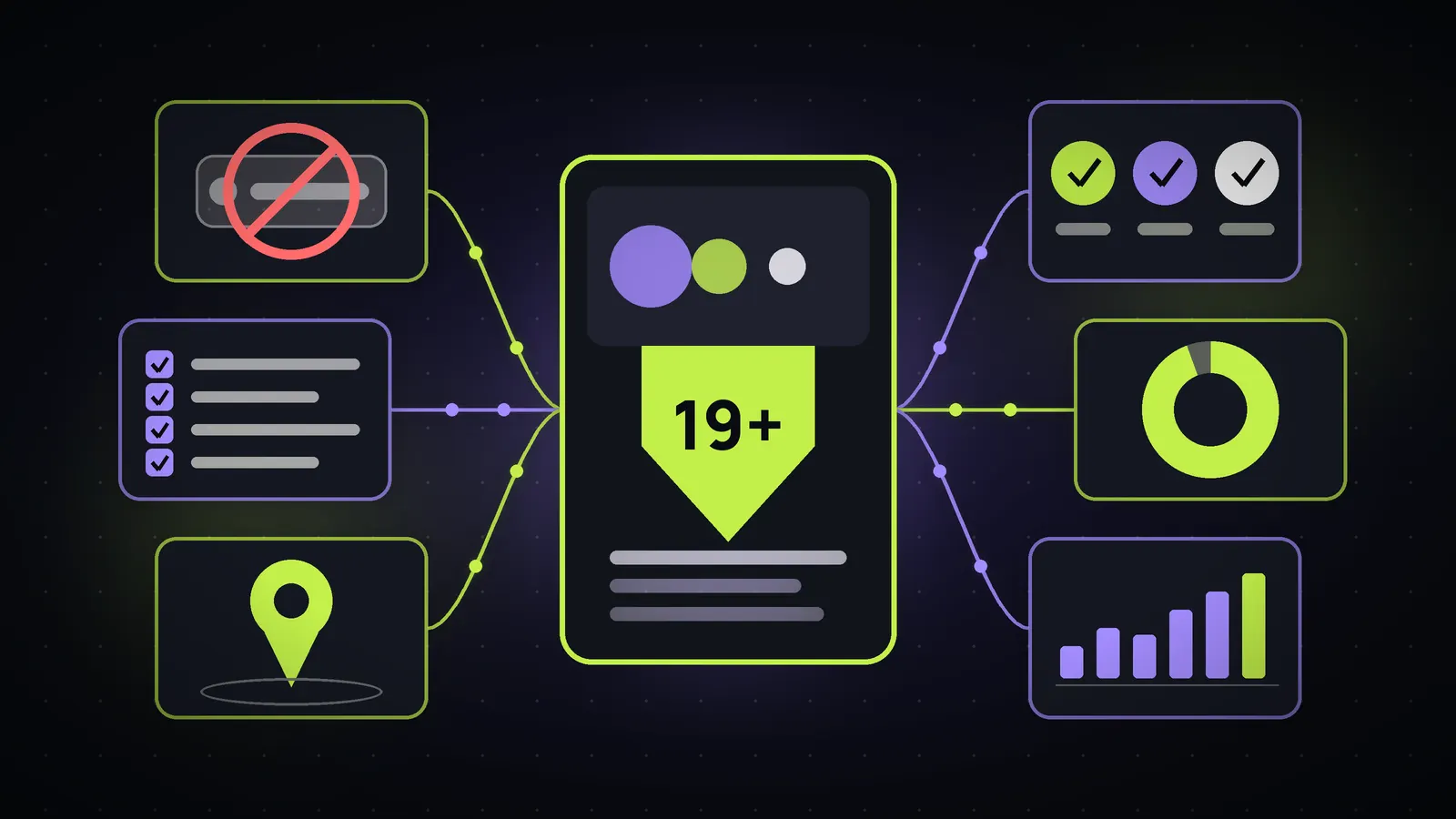
Ontario was the first Canadian province to open a regulated online casino market to private operators, in April 2022. It is a large, attractive market, and it is also one of the stricter places in North America to advertise gambling. The rules are set by the Alcohol and Gaming Commission of Ontario (AGCO) in the Registrar's Standards for Internet Gaming, and they apply to the operator, to the agencies and affiliates working for it, and to every channel from search ads to livestreams.
This guide is for registered operators, and for the affiliates and marketing teams that work with them, who want to plan an Ontario campaign that grows the brand without putting the registration at risk. It covers who can advertise, what the AGCO standards actually say, what is allowed and what is not, how each channel works, a step-by-step launch process and a checklist you can use before anything goes live.
Not legal advice. This article summarizes public sources we checked on 19 November 2026. Rules and platform policies change, and your own legal and compliance team should sign off every campaign before launch.
Who can advertise an online casino in Ontario
Only operators that are part of Ontario's regulated market should be marketing online casino games to Ontario players. To get there, a private operator must register with the AGCO and sign an operating agreement with iGaming Ontario before offering games to players in the province. The two bodies have separate roles: the AGCO regulates the market, and iGaming Ontario conducts and manages igaming provided through private operators.
The ad platforms follow the same line. Google's gambling policy for Canada says operators of sports betting and online casinos must be licensed by the relevant province and target only that province. Meta, TikTok and the streaming platforms ask for proof of licensing too. In practice, an unregistered offshore site has no compliant way to run paid ads in Ontario, and an agency or affiliate that helps it do so creates a problem for every registered operator it also works with (more on that in the affiliate section).
The AGCO advertising standards in plain English
The marketing rules sit mainly in Standards 2.03 to 2.08 of the Registrar's Standards, with third-party rules in 1.19 and 1.21. Here is what they mean for a campaign plan.
No targeting or appealing to minors and high-risk players (2.03)
Ads must not target high-risk, underage or self-excluded people, must not include underage individuals and must not knowingly be sent to high-risk players. That includes themes or language that appeal primarily to minors, outdoor ads directly next to schools or youth-oriented places, media where most of the audience is reasonably expected to be minors, and people who are, or look like, minors. The legal age to play in Ontario's igaming market is 19.
No athletes, and no celebrities or influencers likely to appeal to minors (2.03)
Since February 28, 2024, active or retired athletes with an arrangement with an operator cannot appear in igaming advertising or marketing, except for the exclusive purpose of advocating responsible gambling. The same update tightened the wider rule: cartoon figures, symbols, role models, social media influencers, celebrities or entertainers who would likely be expected to appeal to minors are not allowed. The AGCO's guidance reads "athlete" broadly, from professional leagues and Olympians to eSports, darts and bowling.
Truthful ads, no promise of winnings (2.04)
Marketing must be truthful and must not mislead. It cannot present winning as the probable outcome, suggest that playing longer or spending more improves your chances, present gambling as an alternative to employment or a financial investment, or suggest it can solve personal problems, improve self-esteem or lead to social or sexual success. Offers that are not reasonably attainable without substantial losses are out as well.
No bonuses or inducements in public advertising (2.05 to 2.07)
This is the rule that changes media plans the most. Advertising that communicates gambling inducements, bonuses or credits is prohibited, except on the operator's own gaming site and in direct marketing to players who have actively opted in. The AGCO's guidance says this covers all public advertising, including targeted and algorithm-based ads. Its advertising and marketing notice lists examples such as sign-up and deposit offers, boosted odds and stake-back offers, and says indirect references count too, including promo codes, affiliate links and descriptions, search engine results and chat rooms. Consent must be collected on the Ontario gaming site itself. Where offers are allowed, the material conditions must be shown at first presentation, and nothing can be called "free" or "risk-free" if the player has to risk their own money.
A responsible-gambling message on every ad (2.08)
All advertising and marketing materials must contain a responsible-gambling message. Registration pages and player account pages must also show a responsible-gambling statement and the number for ConnexOntario (Standard 2.09).
The operator answers for its partners (1.19 and 1.21)
Operators are responsible for the third parties they contract with, who must act as if they were bound by the same laws and standards. Standard 1.21 adds that operators must not use marketing affiliates that also promote online gaming sites accepting Ontario players without AGCO registration. The AGCO's third-party management page puts this in one place.
What's allowed and what's not
A quick reference for briefing creative and media teams. It is a summary of the sources above, not a complete list.
| Topic | Generally allowed | Not allowed |
|---|---|---|
| Brand advertising | Brand, game and product awareness from a registered operator, with a responsible-gambling message and a 19+ notice. | Promoting a site that is not registered in Ontario's market. |
| Bonuses and offers | On the operator's own site, and in direct marketing to players who opted in on that site, with conditions shown up front. | Sign-up, deposit, boosted-odds or stake-back offers in public ads, search ads, social ads, affiliate copy or promo codes. |
| People in ads | Adult talent who do not appeal to minors; athletes only in ads exclusively about responsible gambling. | Active or retired athletes in promotional ads; influencers, celebrities or cartoons likely to appeal to minors; anyone who is or looks under age. |
| Claims | Accurate descriptions of games, features and responsible-gambling tools. | Implying winning is likely, that gambling is income or an investment, "free" or "risk-free" offers that are neither. |
| Audience and placement | Media and channels with an adult audience, targeted to Ontario and 19+. | Media directed primarily at minors, outdoor ads directly next to schools, targeting self-excluded or high-risk players. |
| Partners | Agencies and affiliates contracted to follow the same standards, with monitoring. | Affiliates that also promote unregistered sites to Ontario players. |
Channel by channel: how to advertise in Ontario
Search ads
Google allows online casino ads in Canada only from certified advertisers whose operator is licensed by the relevant province, targeting only that province, with a landing page that shows responsible-gambling information and no targeting of minors. For Ontario that means a separate, Ontario-only campaign structure. Because the AGCO counts search engine results as advertising for inducement purposes, ad copy, sitelinks and callouts should describe the brand and the games, never the welcome offer. Our Meta and Google ads for casinos service includes the certification and account set-up.
Paid social
Meta allows online gambling ads only after an ad account has obtained Meta's authorization, with evidence that the activity is licensed in the territory being targeted. Meta's own floor is 18, so Ontario campaigns should be set to 19 and over to match the provincial age. TikTok runs its own certification process and allows gambling ads only in the markets on its current list, never to minors, so check that list before planning TikTok spend. On every platform, the bonus rule still applies: no offers in public social ads.
Streaming and influencers
Creator and livestream marketing is where Ontario rules bite hardest. The AGCO restriction covers social media influencers and entertainers who would likely be expected to appeal to minors, so creator selection has to start from audience age data, not follower counts. Platform rules add another layer: Twitch does not allow links or affiliate codes to sites with slots, roulette or dice games and keeps a list of gambling sites that cannot be streamed, while Kick allows sponsored gambling content only for licensed platforms, with clear disclosure and age labelling. Organic creator content is still advertising if the operator is paying for it. See how we plan this on our livestream advertising and influencer ambassador casting pages.
Affiliates
Affiliates are a major acquisition channel in Ontario, and the operator carries the risk. Under Standard 1.19 the affiliate must behave as if it were bound by the same standards, and under 1.21 it cannot also promote unregistered sites to Ontario players. The AGCO's supplier guide notes that some businesses called marketing affiliates may not need their own registration, but that does not change the content rules: an affiliate review page that headlines a welcome bonus to Ontario visitors is public inducement advertising. Operators should audit affiliate sites, link text and promo codes as part of normal compliance work.
SEO and content
Organic search is one of the few always-on channels that fits Ontario's rules well, because it answers questions players are already asking. Game guides, responsible-gambling tools, payment and verification help, and brand pages can all rank. The same limits apply: no inducements in titles, meta descriptions or page copy aimed at the public, a responsible-gambling message on the page, and nothing that suggests winning is likely.
Sponsorships, events and outdoor
Sponsorships and events still work, with care. Athletes cannot front promotional campaigns, outdoor ads cannot sit directly next to schools or youth-oriented locations, and the AGCO has said that neither operators nor other businesses may provide devices for players to access an igaming site at a physical venue. Our events team plans VIP and brand experiences for adult audiences only.
Canadian advertising codes that also apply
The AGCO standards are not the only rulebook. The Canadian Gaming Association's Code for Responsible Gaming Advertising, developed in 2025, is administered by Ad Standards, which began accepting complaints under it on January 1, 2026. It applies in addition to the Registrar's Standards. The Canadian Code of Advertising Standards also covers the content of igaming ads, and members of the public can file complaints under either code.
A step-by-step launch process
This is the order we use for an Ontario campaign. Each step has an owner and a written record, so the operator can show its work if the regulator asks.
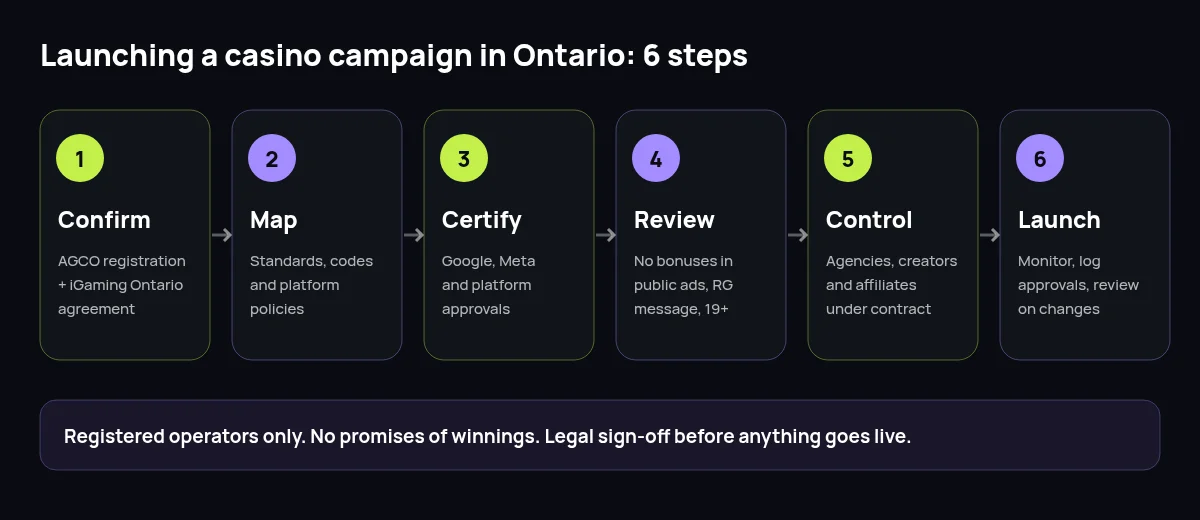
- Confirm eligibility. AGCO registration and the iGaming Ontario operating agreement are in place, and the brand, domains and apps to be promoted are the ones covered.
- Map the rules. Registrar's Standards, the CGA Code, the Canadian Code of Advertising Standards and the policy of every platform in the plan, checked against the current text.
- Certify the platforms. Google gambling certification, Meta authorization and any TikTok or streaming platform approvals, with Ontario-only geo-targeting and 19+ age settings.
- Review the creative. No inducements in public ads, a responsible-gambling message on everything, no athletes, no talent or themes that appeal to minors, no promise of winnings. Legal signs off.
- Control partners. Contracts with agencies, creators and affiliates that bind them to the standards, plus checks that affiliates don't promote unregistered sites.
- Launch, monitor and log. Watch placements, comments and creator content, keep approvals on file and review the plan whenever a standard or policy changes.
Ontario casino advertising checklist
- The operator is registered with the AGCO and has an operating agreement with iGaming Ontario.
- Every ad is geo-targeted to Ontario and set to 19+ where the platform allows it.
- No bonus, credit, boosted-odds or promo-code message appears in any public ad, search ad, social post or affiliate copy.
- Offers appear only on the operator's site and in opted-in direct marketing, with conditions shown at first presentation.
- Nothing is called "free" or "risk-free" unless it truly is.
- Every ad carries a responsible-gambling message.
- No active or retired athletes, except in ads exclusively about responsible gambling.
- No influencers, celebrities, cartoons or themes likely to appeal to minors, and no one who looks under age.
- Creator and media audiences have been checked for age before booking.
- No outdoor placements directly next to schools or youth-oriented locations.
- Google certification and Meta authorization are active, and landing pages show responsible-gambling information.
- Affiliates are under contract, audited, and do not promote unregistered sites to Ontario players.
- Approvals, creative versions and placement reports are kept on file.
What we bring from casino and betting work
We would rather show you what our decks actually say than invent a case study. None of the figures below are Ontario results.
- Livestream network. Our Livestream Advertising deck lists a network of 4,500+ active streamers, 17.1m unique weekly viewers, a 42 min average watch time and 257M+ monthly impressions, across gaming, sports, finance, IRL and other categories. For gambling clients we book only creators and audiences of legal age, channel by channel.
- A livestream campaign at scale. For a Web3 brand (anonymous here, and not a gambling brand), the same deck reports 44.8m North American impressions, 605 unique streamers and over 8,594 downloads each month, based on our own tracking.
- Named betting partners. The deck names Fliff and Polymarket as betting and prediction brands advertising live inside creator broadcasts. We don't publish results for them.
- Poker activations. In November 2024 we pitched WPT Global seven activation ideas to build brand awareness. The brief covered Canada excluding Ontario, a good example of how Ontario is planned as its own market.
How to choose a compliant casino marketing agency
Ask any agency these questions before you sign:
- Do you work only with registered operators in Ontario, and will you put that in the contract?
- Who on your team reads the Registrar's Standards and platform policies, and how do you track changes?
- How do you check a creator's audience age before booking?
- How do you keep inducements out of public ads, search copy and affiliate content?
- What records will we get for approvals, placements and creative versions?
- Will you tell us when a tactic is not allowed, even if it would perform?
If the answers are vague, keep looking. If you want to see how we work, start with our casino marketing services or our strategy discovery engagement, which produces the compliance map and plan before any spend.
Sources
Checked on 19 November 2026: AGCO Registrar's Standards for Internet Gaming (last updated May 14, 2026); AGCO, ban on athletes in igaming advertising; AGCO, advertising and marketing in Ontario's igaming market; AGCO, internet gaming suppliers application guide; iGaming Ontario; Ad Standards; Google Ads gambling policy; Meta online gambling policy; TikTok gambling ads policy; Twitch Community Guidelines; Kick Community Guidelines.
Frequently asked questions
Can an unregistered online casino advertise in Ontario?
No compliant route exists. Private operators must register with the AGCO and sign an operating agreement with iGaming Ontario before offering games to Ontario players, and Google, Meta and TikTok all ask for proof of licensing before they run gambling ads. Affiliates that promote unregistered sites to Ontario players also put the registered operators they work with in breach of Standard 1.21.
Can I advertise a welcome bonus in Ontario?
Not in public advertising. Standard 2.05 prohibits ads that communicate inducements, bonuses or credits, including targeted and algorithm-based ads, search results, promo codes and affiliate copy. Offers can appear on the operator's own gaming site and in direct marketing to players who actively opted in on that site, with the material conditions shown up front.
Can athletes or celebrities appear in Ontario casino ads?
Since February 28, 2024, active or retired athletes cannot appear in igaming advertising or marketing except for the exclusive purpose of advocating responsible gambling. Celebrities, role models, social media influencers, entertainers and cartoon figures that would likely be expected to appeal to minors are also not allowed.
Can I use influencers or streamers to promote an online casino in Ontario?
Yes, with limits. Creators must be adults who would not likely be expected to appeal to minors, the audience must be checked for age, content needs a responsible-gambling message and no bonus offers, and paid partnerships must be disclosed. Platform rules also apply: Twitch restricts links and codes to slots, roulette and dice sites, and Kick allows sponsored gambling content only for licensed platforms.
Do Google and Meta allow online casino ads in Ontario?
Yes, for licensed operators that complete each platform's process. Google requires gambling certification, an operator licensed by the province, targeting of that province only, a responsible-gambling landing page and no targeting of minors. Meta requires authorization through Meta Business Suite with proof of licensing and does not allow targeting under 18; for Ontario we set campaigns to 19 and over.
Are affiliates responsible for following the AGCO advertising rules?
The operator is accountable, but the rules reach the affiliate. Under Standard 1.19 operators must require third parties to act as if bound by the same standards, and under 1.21 they cannot work with affiliates that also promote unregistered sites to Ontario players. In practice, operators audit affiliate pages, links and codes.
What is the minimum age for online casino advertising in Ontario?
Online casino players in Ontario must be 19 or older, so ads should target adults 19 and over, must not appear in media directed primarily at minors or where most of the audience is expected to be minors, and must not feature anyone who is or looks under age.
Does a responsible-gambling message have to appear in every ad?
Yes. Standard 2.08 says all advertising and marketing materials must contain a responsible-gambling message, and registration and account pages must show a responsible-gambling statement and the ConnexOntario number.
Is this guide legal advice?
No. It is a plain-language summary of public sources we checked on 19 November 2026. Rules and platform policies change, so your legal and compliance team should review every campaign before launch.